
ASC medical coding follows different rules from physician coding, even when the surgeon and the ambulatory surgical center report the same CPT code for the same case. The facility has its own payment mechanism and its own modifier rules. It follows its own edits, so a code that is correct on the surgeon’s claim might turn out to be wrong on the facility’s. For facility coders, copying the surgeon’s codes onto the facility claim can lead to avoidable claim denials.
This guide covers the ambulatory surgery center coding guidelines that are most relevant in 2026: covered procedures, payment indicators, ASC modifiers, bilateral rules, NCCI edits, and documentation. If you’d rather hand this work to specialists, our ASC billing services cover facility coding end to end.
A practical ASC medical coding workflow runs five checks: confirm the procedure is eligible for ASC payment, review its payment indicator, code from the operative documentation, apply the correct facility modifiers, and run the claim through NCCI edits and unit edits before submission. The sections below walk through each one.
The ASC Covered Procedures List and Payment Indicators
Ambulatory coding for Medicare starts with one question: is the procedure allowed in an ASC at all?
How to check a procedure before coding it
In ASC medical coding, start with the latest CMS ASC files, not an old internal code list. CMS publishes the Ambulatory Surgical Center ASC Approved HCPCS Codes and Payment Rates files every quarter, which list each covered code with its payment indicator and national payment rate. Search for the CPT or HCPCS Level II code in Addendum AA, then confirm it isn’t on the Addendum EE exclusion list. Then find the ASC payment indicator for that code to see how Medicare treats the service.
Addendum AA contains Category I and Category III CPT and Level II HCPCS codes used for the ASC payment process, and Addendum DD1 gives a description of each indicator. The indicators coders see most:
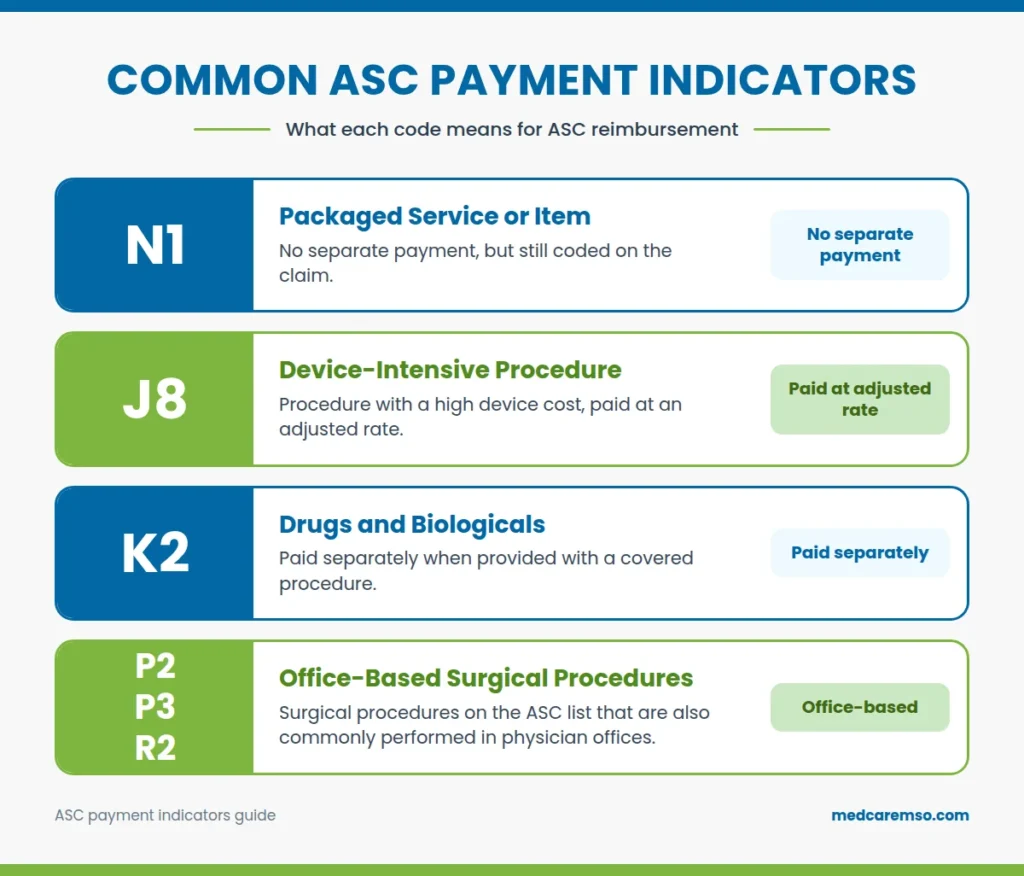
The ASC payment indicator N1 means a packaged service or item with no separate payment. That is a payment rule, not a coding rule. Packaged services such as add-on levels still get coded, because N1 describes how Medicare calculates payment, not that the code is denied or shouldn’t be reported. Commercial payers may pay those lines. Device-intensive procedures (J8) carry the device cost inside the procedure rate. Devices with pass-through status are the exception: they are reported on their own line and paid separately.
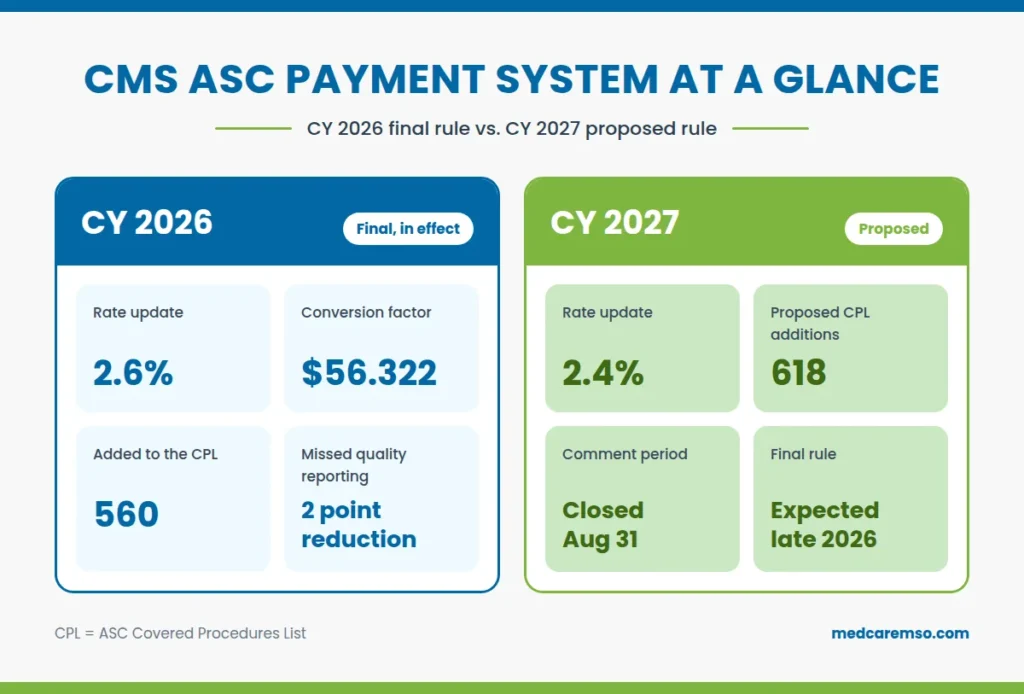
The 2026 final rule is in effect now. The 2027 proposed rule would expand the ASC Covered Procedures List again, adding 618 procedures that track proposed removals from the inpatient-only list. Review ASC coding updates and internal code lists when the final rule is released later in 2026, and again with each quarterly file.
How commercial payers group ASC procedures
Many coders still use the term “Medicare ASC grouper” from Medicare’s pre-2008 payment groups. Today’s ASC fee schedule is set code by code, but many commercial contracts still pay by proprietary groupings, so keep each contract’s grouper list next to the CMS files.
ASC Modifiers: Which Ones Medicare Accepts on Facility Claims
In ambulatory coding, payer and claim format come first. For Medicare, ASC billing on the CMS-1500 (or 837P) uses POS 24, the ambulatory surgical center place of service code, and the surgeon reports the same ASC POS for the case. The SG modifier is obsolete: Medicare stopped requiring it on ASC claims on January 1, 2008.
Some commercial payers and Medicaid programs require the UB-04 (837I) instead. On those claims, the bill type for ambulatory surgery center claims is typically 0831, and common ASC revenue codes include 0490 and 0360. Other plans want the CMS-1500 for every line of business, so check each payer’s manual.
How to choose the right ASC modifier
Start with the scenario that changed how the procedure is reported: a discontinued procedure, an NCCI edit, a device credit, or a screening that turned diagnostic. The scenario points to the ASC modifiers Medicare accepts.
If the procedure is discontinued
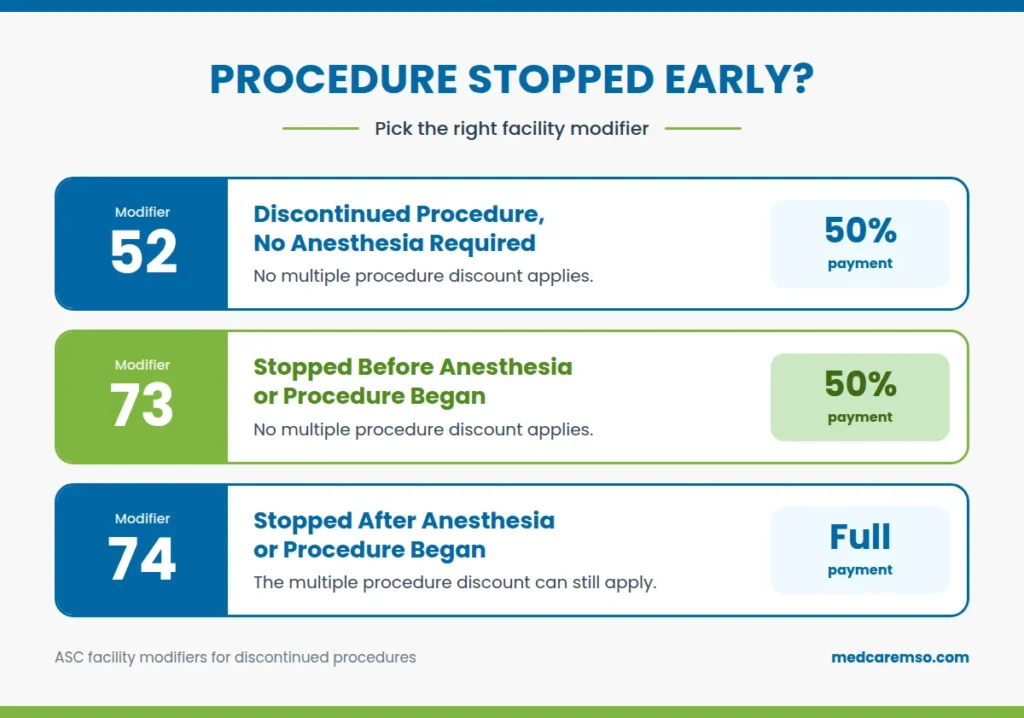
Use 52 for a discontinued procedure that does not require anesthesia, 73 if the patient was prepared and taken to the procedure room but the procedure stopped before anesthesia was induced or the procedure began (Medicare pays 50%), and 74 if it stopped after that point (Medicare pays in full). Lines reported with modifier 52 or 73 are not subject to the multiple procedure discount.
If an NCCI edit bundles two services
Don’t add modifier 59 just because an NCCI edit appears. First confirm the documentation supports a distinct procedural service, such as a separate session, site, structure, or encounter. Then select the X modifier that states the reason (XE, XS, XP, or XU), keeping 59 as the last option.
If the ASC received a device credit
If the ASC received the device at no cost or with full credit, report FB. If it received a partial credit of 50% or more of the device cost, report FC. Never report FB and FC on the same line.
If a screening colonoscopy becomes diagnostic or therapeutic
PT identifies a screening colonoscopy for a Medicare patient that became diagnostic or therapeutic. Many commercial payers ask for modifier 33 instead, so check the payer’s policy.
RT and LT identify laterality where applicable. Bilateral ASC reporting has its own facility rules, covered next.
Are modifier errors costing your ASC?
Let certified facility coders apply the right ASC modifiers before every claim goes out.
Talk to an expertMultiple and Bilateral Procedure Rules
When an ASC reports more than one covered surgical procedure in a session, Medicare allows 100% of the highest-paying procedure and 50% for each of the others, per the CMS Claims Processing Manual, Chapter 14. Addendum AA also shows whether each code is subject to multiple procedure discounting. That column decides whether the multiple procedure reduction applies to ASC procedures.
Applies to procedures that Addendum AA flags as subject to discounting, including bilateral procedures.
How to check a bilateral ASC procedure
- Confirm both sides were treated and check Addendum AA to see whether the multiple procedure reduction applies to the code.
- Apply Medicare ASC facility rules, not the surgeon’s modifier. Report two lines with RT and LT, or 2 units on one line. Medicare rejects ASC claims with modifier 50.
- Expect the 50% reduction on the second side when the procedure is subject to discounting.
- Verify commercial rules separately. Some payers do want modifier 50 on ASC procedures.
NCCI Edits, MUEs, and Medical Necessity
Run these three checks before the claim leaves coding
- Check NCCI edits. ASCs do not use the hospital edit table. Based on the 2026 NCCI Policy Manual, the PTP edits applicable to claims of practitioners are also applicable to claims of ASCs. When a PTP edit applies, follow the modifier steps in the ASC modifiers section above.
- Check MUEs. An MUE is the maximum number of units of a HCPCS/CPT code a provider would report for one patient on one date of service under most circumstances. Verify reported units against the current practitioner MUE table.
- Check diagnosis support. Make sure the ICD-10-CM diagnosis supports every CPT HCPCS code on the claim, including any local coverage rules for pain procedures.
Correct bundling modifiers protect coding compliance, and diagnosis support protects coding accuracy and medical necessity. A diagnosis that doesn’t support the procedure can lead to claim denials.
Documentation That Supports the ASC Facility Claim
Code from the operative note as the source for ASC medical coding, and confirm the clinical documentation records:
- the laterality
- the level, joint, or lesion treated
- the method of treatment
- any implant, with its invoice
- whether the procedure stopped before or after anesthesia, which decides 73 or 74
If any detail that changes the code or modifier is missing, don’t borrow it from the surgeon’s claim. Query the surgeon and code from the corrected note.
The ASC bills under its own Type 2 NPI and its own Medicare ASC enrollment, not the surgeon’s. Match the billing provider on every facility claim to that enrollment record. Regular coding audits, which compare medical records with coding, can discover gaps in documentation before the payer does.
Commonly Coded ASC Procedures in 2026
These ambulatory surgery coding examples cover the outpatient procedures ASCs report most often, and the coding rule each one illustrates:
| Specialty | Code | Procedure | Coding rule illustrated |
|---|---|---|---|
| Ophthalmology | 66984 / 66982 | Cataract surgery with IOL, standard / complex | Laterality: report each eye with RT or LT; the IOL is packaged into the procedure payment |
| GI | CPT code 45378 | Diagnostic colonoscopy | Diagnostic vs. therapeutic: switch to the therapeutic code if an intervention is performed |
| GI | 45380 / 45385 | Colonoscopy with biopsy / snare removal | Screening conversion: PT for Medicare; many commercial payers want 33. See our gastroenterology billing services. |
| GI | 43239 | EGD with biopsy | Two endoscopies, one session: the lower-paying procedure is reduced 50% when both are subject to discounting. |
| Pain management | 64483 | Transforaminal epidural, lumbar/sacral, single level | Bilateral reporting: RT and LT lines; never use modifier 50 for Medicare. Check Addendum AA before billing add-on levels (64484), which may be packaged. |
| Pain management | 64635 | Radiofrequency ablation, lumbar facet, single joint | Units: coded per joint, not per nerve. |
For cataract surgery, the ASC does not bill a conventional intraocular lens separately. Its payment is included in the procedure payment for 66984 or 66982. For pain management, check bilateral and add-on rules first, because they change both the claim lines and the payment. More surgical procedures move into outpatient surgery each year as CMS expands the covered list; the CY 2026 additions included codes for POEM (CPT 43497) and EndoFLIP (CPT 91040).
Keep up with CMS ASC coding updates
We track the ASC Covered Procedures List and payment indicators every quarter, so your coders don’t have to.
ASC Coding Best Practices to Reduce Denials
These ASC coding guidelines help reduce avoidable facility denials.
Pre-submission ASC coding checklist
Before releasing the facility claim, confirm:
- The procedure’s ASC payment status was checked against this quarter’s Addendum AA and EE.
- The ASC payment indicator was reviewed, and packaged N1 lines are still coded.
- The CPT/HCPCS codes correspond with the surgical notes.
- The ICD-10-CM code supports each service submitted.
- Facility modifier rules were applied instead of the surgeon’s: RT/LT instead of 50, and 73/74 instead of 53.
- Practitioner NCCI edits and MUEs were checked.
- Device credits were reported with FB or FC where they apply.
- Documentation for any discontinued procedure supports the modifier used.
Run monthly coding audits against this checklist, feed the findings back into coder education, and tie each coding denial to its root cause so the same error doesn’t repeat. That is the core of coding compliance.
Teams short on certified facility coders can use outside medical coding services, and our denial management services help trace repeat coding denials to their source.
Final Thoughts
Ambulatory surgery center coding rewards precision: the right code on the covered list, the facility’s own modifiers, and documentation that proves every line. As CMS keeps expanding the covered procedures list, ambulatory surgery centers take on more complex same-day surgery, and each new case adds codes, indicators, and edits that test coding accuracy. If your team needs support, our ASC billing services handle facility coding from the op note to the clean claim.