
When someone you love enters hospice, the first thing many people feel is the desperate silence. You may rehearse the perfect script to console them, but somehow the words always fall short of your true feelings. Every sentence you come up with sounds too small or too final. That is a normal response to a hard moment. Knowing the end is inevitable at staring right at you can have this effect.
Here is the reassurance most families need first: the most encouraging words for hospice patients are usually the simplest. This guide gives you words of encouragement for hospice patients that you can say out loud, explains what to avoid, and shows how to be with someone when words run out.
The most comforting words for someone in hospice are simple and personal: “I love you,” “I’m here with you,” “Thank you,” and “You matter to me.” Avoid forcing positivity or promising that everything will be okay. Follow the person’s lead, and remember that quiet presence can be comforting too.
What to Say to Someone in Hospice
Say that you love them, that you are here, that they matter, and that you are not going anywhere. Speak to the person, not the illness.
In The Four Things That Matter Most, palliative care physician Ira Byock describes four phrases that help people tend to important relationships: “Please forgive me,” “I forgive you,” “Thank you,” and “I love you.” You do not need all four, or any of them if they do not fit your relationship.
Three rules make any phrase land better:
- Say the person’s name, and yours, especially if they are tired or drifting.
- Keep visits short and let the person set the pace.
- Ask before you assume: “Would you like company, or would you rather rest?”
Comforting Phrases by What They’re Feeling
These encouraging words for hospice patients are grouped by what the person may be feeling. Change any word that does not sound like you, because the best words for someone in hospice are in your own voice.
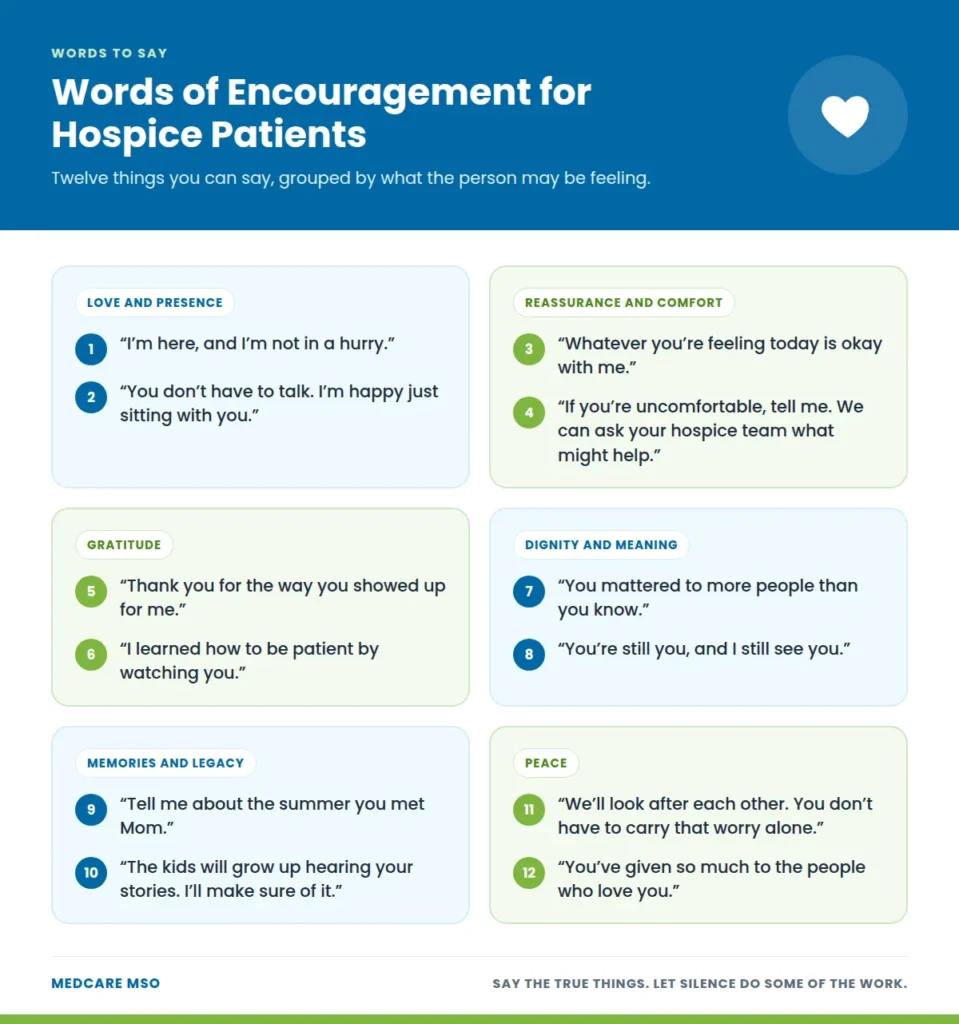
Permission phrases such as “It’s all right to rest now” can be deeply meaningful for some families and wrong for others. Use them only when they fit the relationship and the moment, never to hurry anyone. None of these lines ask the person to feel better or be brave. Words of encouragement for hospice patients work by helping someone feel loved, safe, and seen exactly where they are.
What to Say to Someone Entering Hospice
Knowing what to say to someone entering hospice starts with what has not changed: your relationship, your presence, and your willingness to listen. Starting hospice does not mean the person has given up, and no one can predict exactly when death will occur. Some patients stabilize or improve enough to leave hospice care.
Hospice care focuses on comfort rather than cure. A person chooses it when cure is no longer the goal, and can change their mind later. An interdisciplinary team, usually a hospice nurse, an aide, a social worker, a chaplain, a physician, and volunteers, cares for the person at home or in a facility, with dignity and quality of life as the goal.
Under the Medicare Hospice Benefit, a person qualifies when their hospice doctor and their regular doctor, if they have one, certify a life expectancy of six months or less if the illness runs its usual course, and the person signs a statement choosing hospice care. The hospice team can explain eligibility for a specific person, and the official Medicare booklet, Medicare Hospice Benefits, covers the details.
Is palliative care the same as hospice? Not exactly. Palliative care can be provided at any stage of a serious illness and alongside disease-directed treatment. Hospice is a form of palliative care for the end of life.
Words that fit this moment: “I’m glad you’ll have people whose whole job is your comfort.” “This doesn’t change anything between us.” “What would make the next few weeks feel good to you?”
What Not to Say to Someone in Hospice
Avoid phrases that ask the person to perform optimism, deny what is happening, or center your feelings over theirs. Well-meant positivity, sometimes called toxic positivity, can make it harder for a person to talk honestly about fear, sadness, anger, or what they know is happening.
| Avoid | Why it can hurt | Try instead |
|---|---|---|
| “Stay positive” or “keep fighting” | Can make the person feel responsible for appearing hopeful | “You don’t have to be positive for me.” |
| “Everything happens for a reason” | May dismiss grief or fear | “I don’t understand it either. I’m here.” |
| “At least you’ve had a long life” | Minimizes what they are losing | “I wish we had more time too.” |
| “You’re going to beat this” | Offers reassurance you cannot guarantee | “I’ll be with you through this.” |
| “I know how you feel” | Assumes their experience | “I can’t imagine. Tell me, if you want to.” |
| “Let me know if you need anything” | Puts the work on them | “I’ll come Thursday and bring lunch.” |
| “You look great” | Can ring false | “It’s so good to see your face.” |
Hospice Messages for Family and Loved Ones
Family members often need encouragement as much as the patient does. They may be carrying anticipatory grief, the mourning that begins before a death, on top of caregiver stress. Hospice messages to family work best when they are specific and expect nothing back.
- To a husband or wife: “I can see how much effort you have put into caring for your sick spouse.”
- To a grown child: “You have made tough decisions in the past, but you have shown a lot of love in doing so.”
- To a caregiving spouse: “I can help you out this week.”
If a friend has a loved one in hospice, focus less on the illness and more on them. “How are you holding up?” followed by a specific offer means more than “Let me know if you need anything.”
If children will visit, prepare them for what they will see, keep the visit short, and let them bring a drawing. The hospice social worker can help.
Hospice social workers and chaplains support families too, and CaringInfo, from the National Alliance for Care at Home (formerly NHPCO), offers caregiver guidance.
Spiritual and Faith-Based Words of Comfort
Spiritual words comfort when they match the beliefs of the person who is dying, and can wound when they do not. Ask first: “Would it help if I prayed with you?” Hospice chaplains support people of any faith and of none.
If prayer or scripture belongs to the person’s tradition, you might say “May you be held in peace tonight,” or read Psalm 23 aloud, slowly and softly. If the person is not religious, try “I hope today brings you some peace” or “You’ve been loved by so many people, and that doesn’t end.”
How to Be Present When You Don’t Know What to Say
Being present means giving the person your full attention without needing to fill the room. Listening, reflecting back what you hear, and allowing silence help someone feel heard.
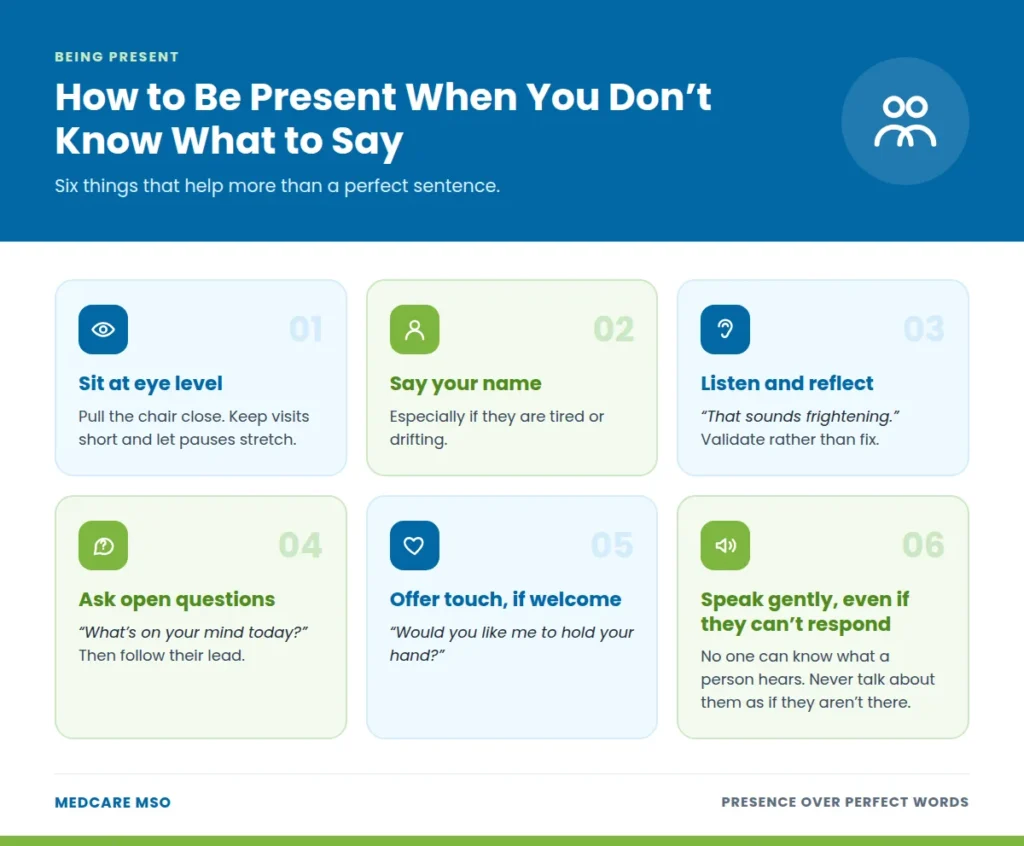
Notice what soothes them: music, a familiar blanket, a window opened.
Many people nearing the end of life worry about who and what they will leave behind. When you can do so truthfully, reassuring them that those people and tasks will be looked after can ease one source of worry.
What to Say When Someone Is Actively Dying
Hospice staff use “actively dying” or “transitioning” for the final days or hours. The National Institute on Aging describes the changes families may notice.
Keep your words few and soft. Say your name first, then what you came to say: “I’m right here.” “I love you.” “Thank you for everything.” “We’ll take care of each other.” If permission phrases fit your relationship, this is where they belong: “It’s all right to rest now.”
Speak even if there is no response. Hearing may persist near the end of life, according to a small University of British Columbia study, though no one can know what a person hears. Sit close and keep the room quiet.
If you notice a change and are not sure what to do, call the hospice team’s 24-hour line rather than 911. The nurse can guide you by phone or come to the home.
What to Write in a Card for Someone in Hospice
A message for someone in hospice should ask nothing back and avoid get-well language. A card can be read again on a hard afternoon, so keep it short and specific to the two of you.
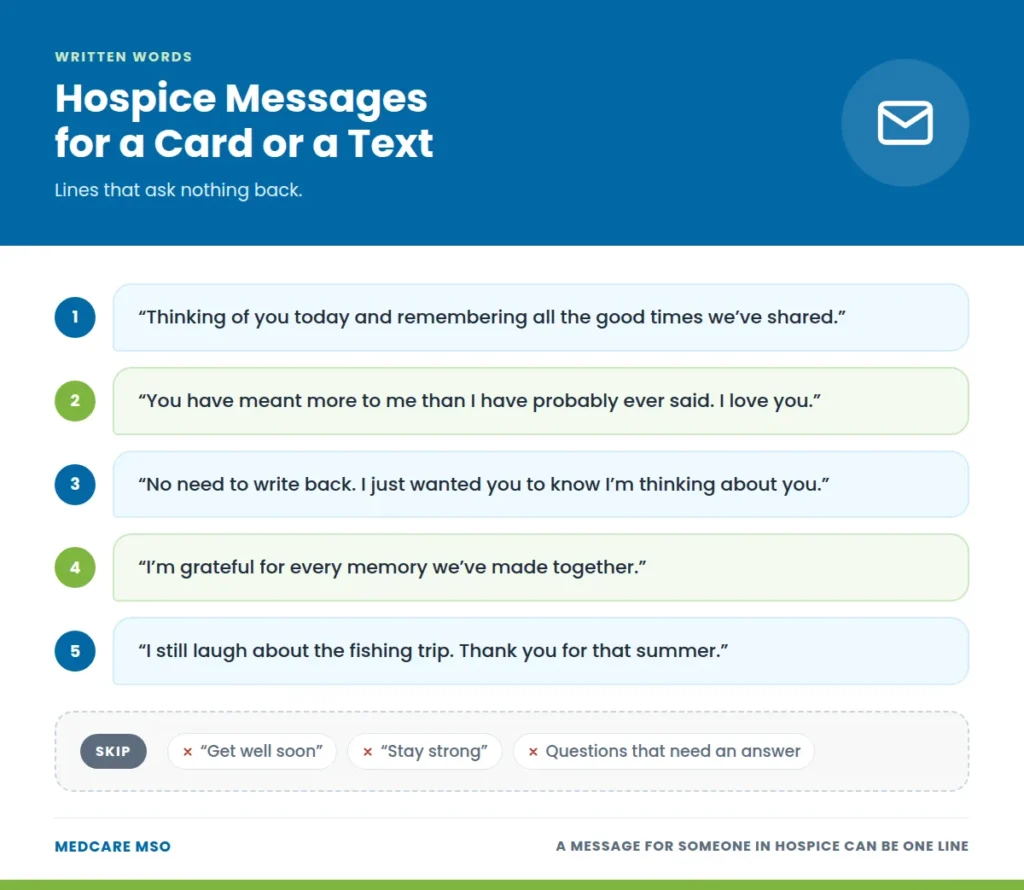
The same message for someone in hospice works as a text, and a voice note lets someone hear you when you cannot be there.
Hospice Care Quotes You Can Share
Quotes from hospice pioneers
Dame Cicely Saunders, who founded St Christopher’s Hospice in London in 1967 and with it the modern hospice movement, put the philosophy of hospice care in one sentence: “You matter because you are you, and you matter to the end of your life.” (King’s College London)
Ira Byock’s The Four Things That Matter Most (2004) gives families the four phrases quoted earlier.
Original Words of Support: Hospice Quotes for Patients
Many quotes for hospice patients online are misattributed to authors who never said them. The quotes for hospice patients below are original hospice care quotes written for this page, so use them in your own voice.
“You are not a burden. You are the reason we show up.”
Family hospice quotes and hospice caregiver quotes
“You cannot do everything, and you were never meant to. Let us carry some of it.”
Inspirational quotes for hospice workers and nurses
The most meaningful inspirational hospice nurse quotes are specific and true rather than grand:
“Every time you came back the next day, we breathed easier.”
Words of support: hospice quotes like these fit a card, a memory book, or a note left at the bedside.
If paperwork is taking your team away from moments like these, see how our hospice billing services can help.
Conclusion
You will not find a perfect sentence, and the person you love is not waiting for one. The most encouraging words for hospice patients are the true ones. Presence, honest words and patient listening do more than any speech. Show up, say the true things, and let silence do some of the work.
Keep your team at the bedside.
Notices of Election, benefit period tracking, and hospice claims take hours your staff would rather spend with patients and families. MedCare MSO’s hospice billing team works on that paperwork so your nurses, aides, and chaplains don’t have to.
Talk to our hospice billing team