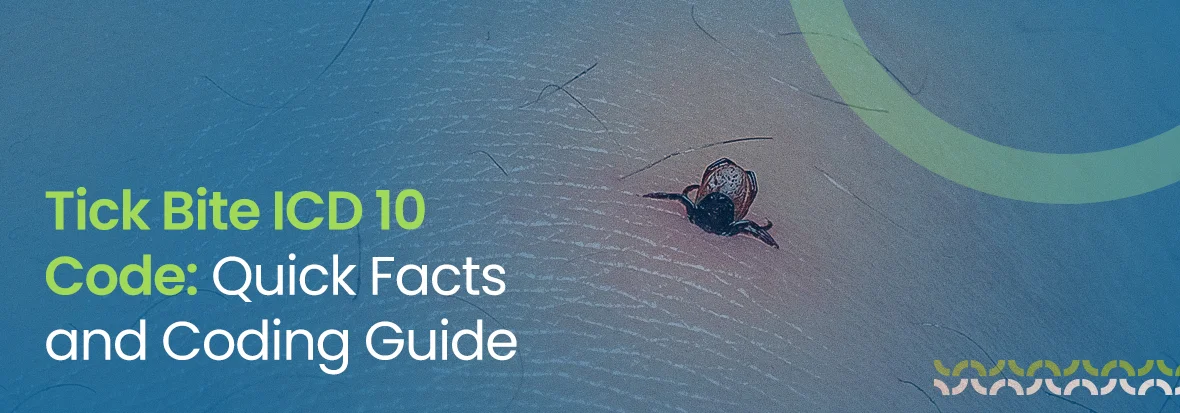
Looking for the ICD-10 code for a tick bite? The code commonly used for the initial encounter is W57.XXXA. This is an external cause code and should not be reported alone. It is typically assigned alongside a code that identifies the injury site, such as S70.362A for a tick bite on the left thigh. This guide, updated for the FY2026 ICD-10-CM code set, explains how to correctly code different tick bite scenarios, documentation requirements, and related ICD-10-CM codes.
What Is the ICD-10 Code for a Tick Bite?
The primary ICD-10-CM code used for a tick bite is:
| Scenario | Code | Descriptor |
|---|---|---|
| External cause, initial | W57.XXXA | Nonvenomous insect or arthropod bite, initial encounter |
| Bite, left thigh, initial | S70.362A | Nonvenomous insect bite, left thigh, initial encounter |
| Bite, scalp, initial | S00.06XA | Nonvenomous insect bite, scalp, initial encounter |
| Bite, lower back and pelvis | S30.860A | Nonvenomous insect bite, lower back and pelvis, initial encounter |
| Suspected exposure or prophylaxis | Z20.828 | Contact with and suspected exposure to communicable diseases |
| Lyme disease, confirmed | A69.20 | Lyme disease, unspecified |
| Lyme disease with meningitis | A69.21 | Meningitis due to Lyme disease |
| Lyme disease, nervous system | A69.22 | Other neurologic disorders in Lyme disease |
| Rash, pending diagnosis | R21 | Rash and other nonspecific skin eruption |
| Fever, pending diagnosis | R50.9 | Fever, unspecified |
Important: W57.XXXA is an external cause code and may need to be reported with additional diagnosis codes depending on the patient’s symptoms, injury location, or complications.
Tick Bite ICD-10 Coding by Patient Scenario
The correct ICD-10-CM code depends on the patient’s clinical situation, documentation, and encounter type.
| Patient Scenario | Coding Consideration |
|---|---|
| Patient presents after a tick bite | W57.XXXA may be reported for the initial encounter |
| Patient returns for follow-up care | W57.XXXD may apply for subsequent encounters |
| Tick bite results in Lyme disease | Additional Lyme disease diagnosis coding may be required |
| Tick bite causes skin infection | Additional infection-related diagnosis codes may apply |
| Exposure involves an unknown insect or arthropod | Different insect bite codes may be appropriate |
Proper documentation helps determine the most accurate ICD-10-CM coding combination.
ICD 10 Code for Tick Bites
ICD 10 documentation of tick bites ensures good records. This helps with patient care and tracking of tick bite and Lyme disease trends. Records should specify where the tick bite was and the tick as the external cause using separate codes.
ICD-10-CM has a standardized language for documenting diagnoses, including tick bites. Diagnosis codes describe the injury and where it is. This allows for communication among providers and good patient care.
ICD 10 codes help track and analyze data on tick bites. This data is important for trending, understanding tick borne diseases, and developing public health strategies to prevent and manage them.
Looking into coding for tick bites shows how important accuracy and detail are.
Fix Your Tick Bite Coding Errors!
Avoid claim denials and underpayments with expert ICD-10 coding support for tick bite diagnoses, documentation accuracy, and faster reimbursements.
Thorax
Front Wall of the Thorax
When coding a nonvenomous insect bite on the front wall of the thorax, use the S20.36x family with the correct 7th character (A for initial, D for subsequent, S for sequela):
- S20.361A – Right front wall of thorax, initial encounter
- S20.362A – Left front wall of thorax, initial encounter
- S20.363A – Bilateral front wall of thorax, initial encounter
- S20.364A – Middle front wall of thorax, initial encounter
- S20.369A – Unspecified front wall of thorax, initial encounter
Back Wall of the Thorax
For bites on the back wall of the thorax, use the S20.46x family with the correct 7th character:
- S20.461A – Right back wall of thorax, initial encounter
- S20.462A – Left back wall of thorax, initial encounter
- S20.463A – Bilateral back wall of thorax, initial encounter
- S20.469A – Unspecified back wall of thorax, initial encounter
Head
Scalp
To document an insect bite on the scalp, use ICD-10 code S00.06 with encounter-specific extensions:
- S00.06XA – Initial visit for the bite
- S00.06XD – Follow-up visit for continued treatment
- S00.06XS – Sequela (complications resulting from the bite)
Nose
For insect bites on the nose, use S00.36, with additional extensions based on the visit type:
- S00.36XA – Initial evaluation
- S00.36XD – Subsequent encounter
- S00.36XS – Sequela
Ear
ICD-10 code S00.46 is designated for nonvenomous insect bites on the ear. It is further classified based on the encounter type:
- S00.46XA – First visit for the bite
- S00.46XD – Follow-up visit
- S00.46XS – Sequela
Neck
An insect bite on the neck is recorded using S10.16, with the appropriate encounter classification:
- S10.16XA – Initial treatment
- S10.16XD – Follow-up evaluation
- S10.16XS – Sequela
Abdomen, Lower Back, Pelvis, and External Genitalia
Nonvenomous insect bites in these regions are coded under S30.86-, with a required 7th character (A initial, D subsequent, S sequela):
- S30.860A – Lower back and pelvic region, initial encounter
- S30.861A – Abdominal wall, initial encounter
- S30.862A – Penis, initial encounter
- S30.863A – Scrotum and testes, initial encounter
- S30.864A – Vagina and vulva, initial encounter
- S30.865A – Male external genitalia (unspecified), initial encounter
- S30.866A – Female external genitalia (unspecified), initial encounter
- S30.867A – Anus, initial encounter
Shoulders and Arms
Shoulder
For bites affecting the shoulder, select the appropriate ICD-10 code:
- S40.261A – Right shoulder, initial encounter
- S40.262A – Left shoulder, initial encounter
- S40.269A – Unspecified shoulder, initial encounter
Upper Arm
When an insect bite occurs on the upper arm, use one of the following codes:
- S40.861A – Right upper arm, initial encounter
- S40.862A – Left upper arm, initial encounter
- S40.869A – Unspecified upper arm, initial encounter
By using the correct ICD-10 codes, medical professionals can ensure precise documentation, facilitating better patient care and accurate medical billing services.
Coding a Tick Bite When the Site Is Not Documented
Here is the mistake that costs the most claims. The site is missing from the note, so the coder reaches for W57.XXXA and submits it alone. That claim gets denied. W57.XXXA can never be primary, even when the location is unknown.
The rule does not change when the site is missing. You still lead with an injury code. You just use the unspecified variant of the right family:
| Body area with no specific site | Unspecified code |
| Upper arm | S40.869A |
| Hand | S60.569A |
| Part of head | S00.96XA |
| No body region documented at all | T14.8XXA |
Note: you may see “T14.03” listed as a tick bite fallback code on some coding websites. T14.03 does not exist in the ICD-10-CM code set — the valid codes for an injury with no documented body region are T14.8XXA (initial encounter), T14.8XXD (subsequent), and T14.8XXS (sequela). Submitting a non-existent code guarantees a rejection.
W57.XXXA still follows as the secondary code.
There are appropriate circumstances for using codes, but an overused set of codes will raise the issue of audits. A specific code such as S40.861A for right upper arm shows good documentation. The use of unspecified codes shows the opposite, and CMS has marked that pattern as indicating that providers are not documenting at the level it should be documented.
The real solution lies upstream of the coding professional. If the note says insect bite, right arm, without further clarification, the coding professional has no choice of a specific code. An improved intake sheet would record the exact location during the visit and remove any possible ambiguity from the claim.
ICD 10 Code for First Encounter with Tick Bite
First encounter with a tick bite should be coded with the ICD 10 code. This code describes the injury and where it is. The first diagnosis code for tick bites must describe the nature and site of the injury and come from the injury chapter.
The code for nonvenomous arthropod bites for first encounters is W57.XXXA. This code is key to good documentation, so providers have a complete record of the patient’s visit. A common mistake is to default to the external cause code without including the injury code. The external cause code, W57.xxxA, should not be the only code submitted on the claim.
Coding for first encounters with tick bites requires two diagnosis codes: one from the injury chapter to describe the nature and site of the injury and an external cause code to identify the tick as the cause. This dual coding ensures good records and billing.
Coding a Tick Exposure with No Injury or Symptoms
Every tick encounter may not result in an injury. Sometimes a patient might visit a doctor after removing a tick at home. In such cases, there are no visible wounds or symptoms yet. The reason behind the visit is exposure alone and not the treated bite.
For such visits, report Z20.828, contact with and suspected exposure to communicable diseases.
This code shows why the patient came in when the visit is precautionary. It also supports the claim when a provider orders Lyme testing or prescribes prophylactic doxycycline before a diagnosis is confirmed.
Z20.828 is the first one to be reported for a pure exposure visit. W57.XXXA is added to show the external cause when a bite is noted down in the records. If the provider prescribes prophylaxis, the exposure code supports the medication and the lab order irrespective of whether an infection was recorded or not.
Coding Follow-Up Visits and a History of Tick Bite
The seventh character in an injury code indicates the stage of treatment for the patient. Coders often times lose the proper payments if they maintain an injury code for a patient after the first service.
A is used for the first visit when the patient is being treated. D designates a visit for the subsequent visit, when the patient is in the recovery process and attends any follow-up treatment. In this case, S means sequela – the illness resulting from the injury. For example, injury code W57.XXXA changes to W57.XXXD or W57.XXXS depending on the visit code.
The tick bite history is different from the follow-up visit. A history matters even if the place of a tick bite is healed and should be reported as a special code. In practice, this means that the payer checks for the injury type even if the bill states “active injury”.
Related ICD-10-CM Codes for Tick Bites and Tick Exposure
When documenting a tick bite, selecting the correct ICD-10 code is essential. The codes should reflect the bite location and any potential complications, such as Lyme disease. Below is a categorized list of ICD-10 codes related to tick removal.
| Category | ICD-10 Code | Description |
| Tick Bites (Without Complications) | S00.06XA | Nonvenomous insect bite on the scalp, initial visit |
| S70.362A | Nonvenomous insect bite on the left thigh, initial visit | |
| S30.860A | Nonvenomous insect bite on the lower back and pelvis, initial visit | |
| W57.XXXA | Bite or sting from a nonvenomous insect or arthropod, initial visit | |
| Lyme Disease (If Diagnosed) | A69.20 | Lyme disease |
| A69.21 | Lyme disease with meningitis | |
| Symptoms Prior to Lyme Diagnosis | R21 | Rash or nonspecific skin eruption |
| R50.9 | Unspecified fever |
Symptoms and Diagnosis of Tick Bites
Tick bites can go unnoticed at first as the bite may not cause immediate symptoms. But skin reactions like rashes or lumps can occur. Some people may develop symptoms of Lyme disease within 3-30 days of a tick bite: fever, chills, and fatigue. Not all will have the classic bullseye rash of Lyme disease; some will have no symptoms at all.
Erythema migrans, a circular rash that spreads over time, is the first sign of Lyme disease from a tick bite. Diagnosing a tick bite involves reviewing the patient’s history and possible exposure to tick infested areas. This is key to identifying tick borne diseases and starting treatment.
Misdiagnosis is common in Lyme disease cases because there is no reliable direct test for the bacteria. If left untreated, it can lead to serious complications: neurological issues, arthritis, and cardiac problems. Accurate diagnosis and early detection are key. Providers must assess symptoms and consider the patient’s exposure history to treat timely and effectively.
Complications from Tick Bites
Lyme disease, caused by the bacteria Borrelia burgdorferi, is the most common tick borne disease in the US. But ticks can also transmit other diseases like Anaplasmosis and Rocky Mountain Spotted Fever. Common symptoms after a tick bite are fever, chills, muscle pain, and headaches.
Rashes from tick bites vary; some indicate specific infections like Lyme disease or Rocky Mountain spotted fever. Lyme disease is reported with A69.20 for the unspecified form. A69.2 is a category header and is not billable on its own.
These complications highlight the need for good documentation and coding. Proper coding of these conditions ensures patients get proper treatment and providers can track and manage tick borne diseases and their consequences.
Treatment and Management of Tick Bites
Managing a tick bite starts with carefully removing the tick with tweezers, as close to the skin as possible. After removing the tick, clean the bite area and your hands with rubbing alcohol, iodine scrub, or soap and water. This immediate care prevents infection and complications.
Watch the tick bite for signs of infection or unusual reactions like increased redness or swelling. If you develop a rash, fever, or flu-like symptoms weeks after a tick bite, seek medical attention. These symptoms may indicate a tick-borne disease that needs medical attention.
Providers are key in managing tick bites and educating patients about the risks and signs of tick-borne diseases. Proper treatment and monitoring prevent serious complications and ensure timely and effective care.
Other Non Venomous Arthropod Bites
ICD-10 codes for nonvenomous insect bites classify and document different types of bites in medical practice. These codes include mosquito bites, flea bites, and other insect bites not leading to venomous reactions. A description of a nonvenomous insect bite is necessary for proper coding. Tick bites have specific ICD-10 codes, other nonvenomous arthropods have separate codes, and arthropods are diverse.
Accurate documentation of the type of bite is important as treatment and management differ between tick bites and other nonvenomous arthropod bites. For example, tick bites need to be monitored for Lyme disease, and mosquito bites are more commonly associated with West Nile Virus or Zika.
Providers must document the specific arthropod bite to ensure proper treatment and follow-up care, some bites can be venomous. Accurate medical records are key to patient safety and disease management.
98.5%
Clean Claims
Maximize Tick-Bite Claim Payments
We manage ICD-10 coding and billing to deliver cleaner claims and stronger revenue results for your practice.
Request a Consultation35%
Reduction in A/R
Which Procedure Code Applies to Tick Removal
There are three different procedure codes for tick removal, which creates issues in billing. The process must be based on what the procedure has been.
If the tick is removed using tweezers, no separate procedure will need to be billed, since no incision has been made. In this case, the service is included as part of an evaluation and management visit, like code 99212 for an established patient. Filing a separate procedure on top of the visit with no specific reason means that claims are likely to be denied.
If the tick has burrowed into the skin, and an incision is made to take it out, the procedure code must be used. The respective code must be either 10120 for a simple incision and removal or 10121 for a complicated one. In this case, a clinical note that would be required to support the code must also provide information about the tool that was used and how deep the incision was.
Some references contain code number 20220, which corresponds to bone biopsy. This procedure code is included on the list by mistake. Make sure to check the code against the correct description of the procedure in the current CPT before submitting it.
Key Guidelines for Coding Tick Removal
Below are the top 9 instructions that you need to follow while coding for tick removal:
- Use Two Diagnosis Codes
When coding for tick bites, include two diagnosis codes: one specifying the injury site and another for the external cause.
For instance, if a tick bite occurs on the left thigh, report S70.362A for the insect bite and W57.XXXA to indicate a bite from a nonvenomous insect.
- Documentation Tips for Providers
Proper ICD-10 coding is key to proper billing and reimbursement of tick bites. This reduces claim denials. Educational training for staff on coding and documentation is important for accurate medical records.
Two codes are needed for tick bites: one from the injury chapter and one from the external cause chapter. Providers often only select the external cause code W57.xxxA. The first code should describe the location of the injury, the body part affected by the tick bite.
If a provider spends 15 minutes removing a tick and assessing the patient, they should document this clearly to support an Evaluation and Management (E/M) code such as 99212.
Blood tests may be needed if symptoms suggest a tick borne disease; identifying the tick can also help with diagnosis. Additional information often included with the ICD code on the medical record are letters indicating diagnostic certainty or body side affected. Proper documentation ensures complete records to support patient care and treatment.
- Differentiate Between Simple and Complex Removals
Code selection depends on the complexity of the procedure.
If the tick is removed easily with tweezers, an E/M code may be appropriate.
If an incision is needed, report 10120 for a simple removal or 10121 for a more complex procedure.
For example, if an incision was made to extract an embedded tick, 10120 should be used.
- Consider Lyme Disease Coding
If a patient exhibits symptoms like a bullseye rash, Lyme disease should be considered in coding.
Use A69.20 for Lyme disease if confirmed.
If the diagnosis is pending, report symptoms such as R21 for rash or R50.9 for fever.
- Assign the Correct External Cause Code
To ensure comprehensive coding, include W57.XXXA to indicate a tick bite.
For example, when documenting a tick bite, include both the injury location and external cause for accuracy.
- Code Multiple Bite Locations Separately
If a patient has multiple bites, assign separate codes for each affected site.
For example, a bite on the left thigh would be coded as S70.362A, while a bite on the neck would be S10.96XA (insect bite of unspecified part of neck). Each site gets its own injury code, with W57.XXXA reported once as the external cause.
- Avoid Upcoding
Only report procedures that were actually performed.
If a tick was removed at home before the visit, do not bill for a removal procedure. Instead, use an E/M code to reflect the consultation.
For example, if a patient comes in for follow-up after a self-removed tick, report only the evaluation.
- Understand ICD-10 Classification
ICD-10-CM places insect bites under Chapter 19: Injury, Poisoning, and Certain Other Consequences of External Causes.
Use an S code to indicate the injury location.
Include W57.XXXA for the external cause.
For example, a tick bite on the right upper arm would be coded as S40.861A for the injury and W57.XXXA for the external cause.
- Train Staff on Accurate Coding
Ensure coding teams are well-versed in documenting tick removal procedures correctly.
Providing training on ICD-10 coding and documentation standards improves accuracy and minimizes claim denials.
Tick Bite Myths
Several myths about tick bites exist, such as that ticks die in winter. Ticks are active whenever the temperature is above freezing. Another myth is that ticks fall from trees; they live on the ground and attach to hosts like animals and humans.
Ticks do not tunnel fully beneath the skin the way some people fear — they attach at the surface and feed until full, usually detaching after several days. However, a tick’s mouthparts can embed deeply enough that an incision is required to remove it, which is when procedure codes 10120 or 10121 apply instead of a standard E/M visit. Remove attached ticks promptly with fine tipped tweezers; do not use burning or chemicals. Proper tick removal is using tweezers to pull the tick out without twisting.
To prevent tick bites, use repellents with DEET, picaridin, or oil of lemon eucalyptus. Public awareness and education are key to preventing tick bites and early detection and treatment of tick borne diseases.
Documentation Requirements for Tick Bite Coding
Accurate tick bite coding depends on complete clinical documentation. Providers should include:
- Location of the tick bite
- Date of exposure
- Tick removal details
- Symptoms reported
- Signs of infection
- Testing performed
- Medications prescribed
- Follow-up recommendations
Complete documentation helps coding teams select appropriate ICD-10-CM codes and reduces claim errors.
The Bottom Line
In summary, proper documentation of tick bites with ICD-10 codes is key to patient care and prevention of tick borne diseases. So providers can track and manage tick bites and provide proper care.
By knowing the diagnosis codes, the process for coding initial encounters, and the trends for tick bites and associated illnesses like Lyme disease, providers can improve patient outcomes and public health. Make Sure you receive complete reimbursement for your tick removal services. Our specialized medical billing and coding services are designed to maximize your payments and prevent unnecessary claim denials. Stay informed, document accurately, and take preventive measures to protect yourself and others from tick bites and complications.
Frequently Asked Questions About Tick Bite ICD-10 Coding
W57.XXXA is an external cause code, not a diagnosis code — it describes how the injury happened, never what the injury is. It must always be paired with an injury diagnosis code (S-code) identifying the bite site, and it cannot be the primary or only code on a claim.W57.XXXA, which can be used when supporting documentation is available.