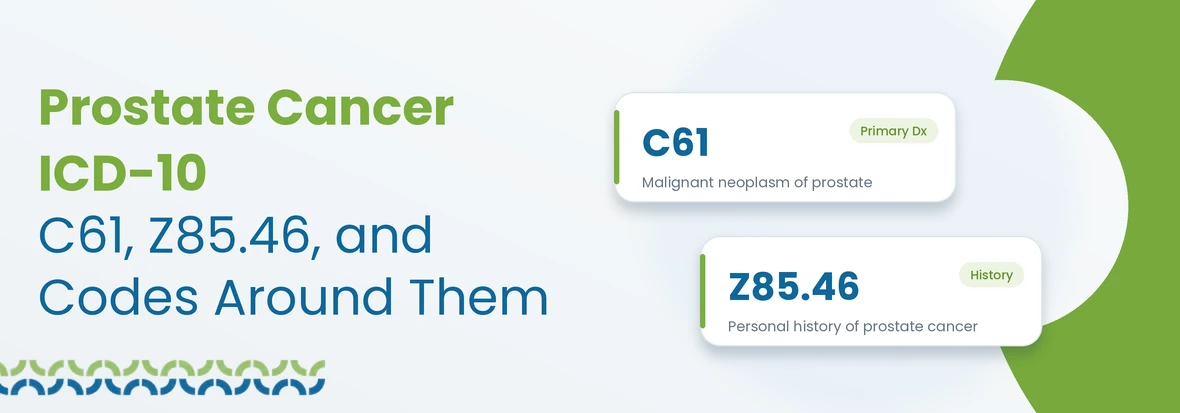
The ICD 10 code for prostate cancer is C61, malignant neoplasm of prostate. Who is this for? If someone wants to find the icd 10 code for prostate cancer, the answer is C61. The codes around it are Z85.46, R97.20/R97.21, Z12.5, D07.5, C79.51. The prostate cancer ICD 10 describes the cancer but does not tell anything about the stage and the risks involved. The simplicity of this code is a trap, and the claim must carry other codes that give more information to the payer.
The ICD-10 Code for Prostate Cancer: C61
The prostate gland is a single midline organ and the C61 ICD-10 code is malignant neoplasm of the prostate. However, pathology lab tests (biopsy or surgical pathology) are required to diagnose the cancer. An elevated PSA or an abnormal exam or an MRI which is suspicious are not the C61. This code does not explain the stage or grade of the cancer.
The malignant neoplasm of the seminal vesicle is C63.7 and it is an Excludes1 under C61. Prostate cancer that extends into seminal vesicles is still C61. Why? Because the prostate is where it started. A cancer that started in the seminal vesicle is C63.7. So, one or the other is used on the medical claim, they are never used on the same claim.
Under C61, the tabular prints: use additional code, if applicable, to identify hormone sensitivity status (Z19.1 hormone-sensitive, Z19.2 hormone-resistant) and rising PSA following treatment (R97.21). Now, this is not a suggestion but it is an instruction printed in the code book. When the hormone status or an elevated PSA is on the chart, those codes go on the claim with C61. C61 and the seven codes this article is built on (Z85.46, Z80.42, R97.20, R97.21, Z12.5, D07.5, C79.51) are unchanged in FY 2027.
C61 vs Z85.46: Active Cancer or History?
The Guidelines give three tests and all must pass before Z85.46 (history of prostate cancer ICD 10): the cancer was excised or eradicated, there is no further treatment directed at that site, and there is no evidence of existing disease. If any of these fail, the prostate cancer ICD-10 code is still C61. What does Z85.46 do on a claim? It tells the payer why this patient gets surveillance PSAs and follow-up visits without an active diagnosis.
| Patient status | Code | Why |
|---|---|---|
| Biopsy-confirmed, awaiting or in treatment | C61 | Cancer is current |
| Post-prostatectomy, on continuing androgen deprivation therapy (ADT) | C61 | Treatment still directed at the cancer |
| Active surveillance (confirmed low-risk, no treatment, being monitored) | C61 | Disease is present even though untreated |
| Treated, no evidence of disease, no ongoing therapy | Z85.46 | History: eradicated, no treatment, no disease |
| Treated, PSA now rising, recurrence not yet confirmed | Z85.46 + R97.21 | History plus the biochemical finding (see After Treatment below) |
| Treated, recurrence confirmed by imaging or biopsy | C61 (+ metastatic site code if applicable) | Cancer is current again |
Before the Biopsy: R97.20, Z12.5, and Screening Rules
The outpatient rule is that the suspected cancer is not coded, but the findings are coded. When there are no pathology reports, there is no cancer to code. The reason the test was ordered is coded.
Z12.5 says: encounter for screening for malignant neoplasm of prostate. Screening means asymptomatic, no personal history, no abnormal findings that drove the test. Let’s discuss Medicare specifics. The screening PSA is HCPCS G0103, not CPT 84153, covered once every 12 months for men 50 or older. Z12.5 is the diagnosis Medicare expects on the claim. Screening DRE is G0102. Z80.42 is the family history of malignant neoplasm of the prostate. It is reported as a secondary code. It supports early screening or a more frequent one.
R97.20 is an elevated prostate specific antigen. This is used when the PSA is high and there is no cancer confirmed. It pairs with 84153. Be careful of the mismatch which is Z12.5 with 84153 (screening diagnosis, diagnostic test) or R97.20 with G0103 (diagnostic diagnosis, screening test), both get denied. The test and the diagnosis must agree. The prostate biopsy claim carries R97.20 or the symptom codes. C61 is used on the next claim after the pathology report. D07.5 is carcinoma in situ of the prostate, it includes PIN III (high-grade prostatic intraepithelial neoplasia / severe dysplasia). A cancer-chapter code, not C61.
| Encounter | Diagnosis | Test | Payer logic |
|---|---|---|---|
| Asymptomatic annual screen (Medicare) | Z12.5 | G0103 | Screening benefit, once per 12 months |
| Elevated PSA found, no cancer confirmed | R97.20 | 84153 | Diagnostic; medical necessity from the finding |
| Symptoms (LUTS, abnormal DRE) | N40.1 / R39.1x / R97.20 | 84153 | Diagnostic |
| Biopsy encounter, result pending | R97.20 (+ symptom codes) | 55700 biopsy; pathology 88305 or G0416 | C61 is not assigned until pathology confirms |
After Treatment: R97.21 and Biochemical Recurrence
Cancers come back after the treatment and there is a mechanism to check it. There is a number that is a sign that the cancer is back, not any scan. PSA should be near zero after prostatectomy or falling after radiation. If it starts going up, it is a biochemical recurrence. It is a finding and not a confirmed recurrence. R97.21 is rising PSA following treatment for malignant neoplasm of the prostate. This was added in FY2021, effective October 1, 2020. Before that, coders had only R97.20, which says nothing about treatment history.
If the PSA is rising, it does not change whether the cancer is history or current. The treatment status does that. Once the recurrence is confirmed, by a PSMA PET that shows a lesion or by a biopsy, the diagnosis becomes C61 again. R97.21 is the diagnosis that supports PSMA PET in the biochemical-recurrence setting. A denial pattern important to mention here: submitting R97.20 for a post-treatment patient. This shows that the patient was never treated, so the authorization for recurrence imaging has no clinical evidence in the code.
Metastatic Prostate Cancer: C61 + C79.51 and Sequencing
Metastatic prostate cancer is coded on both pathways: primary and secondary sites. C61 and the metastasis code. Bone is the common distant site, so mostly it is C61+C79.51 (secondary malignant neoplasm of bone). C79.51 is never used alone; it is paired with C61, or with Z85.46 when the prostate has been removed and nothing is being directed at the cancer itself. After the prostate is removed, the primary stays C61 as long as treatment of the cancer continues, such as ADT. If no treatment is directed at the cancer and only the metastasis is being treated, the Guidelines (I.C.2.d) call for the metastasis code with Z85.46 as the secondary code.
Discussing some sequencing rules here: Line 1 is the site the encounter treats. If the treatment is aimed at the metastasis, such as radiation to a spinal lesion, C79.51 first and C61 in second place.
| Encounter | Line 1 | Line 2 | Line 3 | Why line 1 is line 1 |
|---|---|---|---|---|
| Radiation to a spinal metastasis | C79.51 | C61 | Z19.1 or Z19.2 if documented | Treatment is aimed at the bone site |
| ADT injection visit, metastatic disease | C61 | C79.51 | Z19.1 or Z19.2 | Systemic treatment for the disease as a whole |
| Chemotherapy for castration-resistant disease | C61 | C79.51 | Z19.2 | Systemic; hormone status drives the drug approval |
| Lymph node metastasis, pelvic nodes treated | C77.5 | C61 | Z19.x | Treatment aimed at the nodes |
| Liver metastasis, systemic therapy | C61 | C78.7 | Z19.x | Systemic |
| Post-prostatectomy, new bone metastases, on ADT | C61 | C79.51 | Z19.x | Treatment of the cancer continues, so the primary is current |
| Surveillance after curative treatment, no disease | Z85.46 | — | — | History; nothing is being treated |
Gleason Score and Grade Group: Not in the Code
ICD-10-CM carries nothing that shows how aggressive prostate cancer is. C61 remains the same for a low-grade tumor on active surveillance and a high-grade tumor with bone metastases. There is no code for the Gleason score, no code for the Grade Group. TNM stage and PSA value, both have no codes.
What is the Gleason score? It is the pathologist’s grade of the biopsy tissue. The two most common patterns in the sample are each graded from 3 to 5 and added together, so the scores that matter in practice run from 6 to 10. The Grade Group, introduced to simplify that scale, compresses the same information into five groups: If the Gleason score is less than or equal to 6, Grade Group is 1, Grade Group 2 is 3+4=7, Grade Group 3 is 4+3=7, Grade Group 4 is 8, and Grade Group 5 is 9 or 10. A pathology report will usually state both.
Prior Authorization: What the Payer Checks Beyond the Code
Prior authorization is an important step before offering services to the patients, especially in the case of prostate cancer treatments. The documentation is the basis of prior authorization, not any code that decides it. These tests are denied or approved on the pathology report and the clinical picture behind the code: radiation (IMRT, SBRT), brachytherapy, androgen deprivation agents, PSMA PET imaging, and genomic classifier tests. If there is a request for IMRT with C61 and it has nothing else, it is not complete. The same request with the Grade Group, the Gleason Score, the latest PSA, the clinical stage, and the treatment history is a complete prior authorization request.
What else is needed in a prior authorization request? The request has to match the diagnosis code. If Z85.46 is submitted with a treatment request for active therapy, it is denied because it is a history code. R97.21 is needed for PSMA PET requests for biochemical recurrence, the reason is that R97.21 is the only code that states the patient was treated. That’s what an oncology billing services team checks before the request is created, not after the claim is denied.