
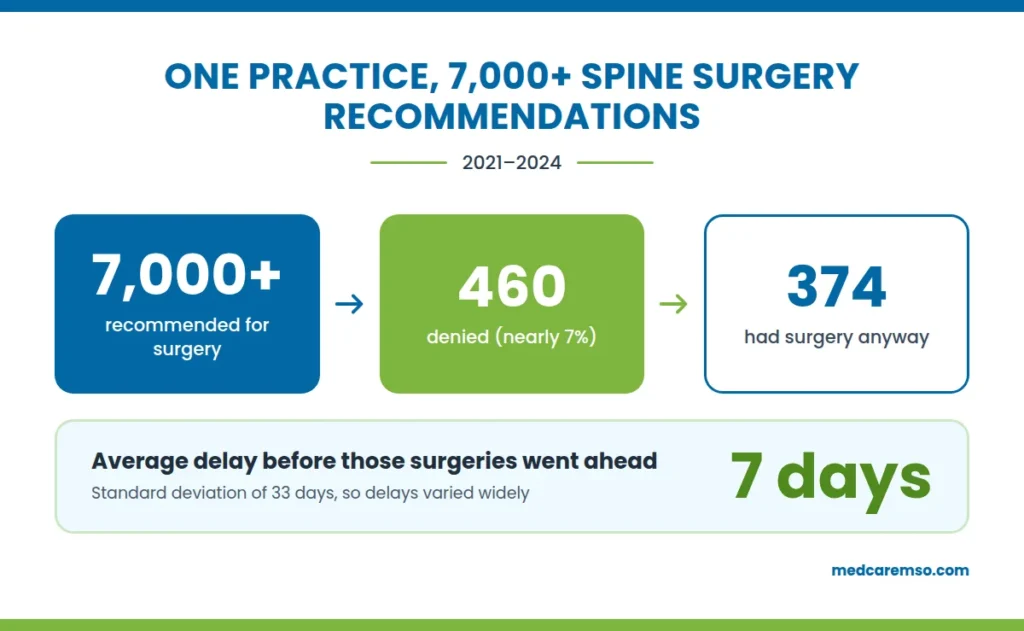
In a review of more than 7,000 elective spine surgery recommendations at one private orthopedic practice, insurers initially denied coverage for nearly 7% of patients. More than four in five of those patients had the surgery anyway, after a delay.
That pattern, a denial followed by the same surgery later, shows why prior authorization challenges are so disruptive and ultimately needs more staff work, rescheduled OR time, and longer waits for patients.
2026 changed the rules without reducing the work. New federal decision deadlines apply to some payers and not others, the Wasteful and Inappropriate Service Reduction (WISeR) Model brought Original Medicare review to selected spine and knee procedures in six states, and most physicians doubt that insurers’ voluntary reform pledges will make a meaningful difference. This guide explains where orthopedic requests stall, which 2026 rules apply to which payers, and how to build preauthorization requests that hold up under utilization management review, alongside everything your billing team already manages.
Prior Authorization Delays and Impact
OrthoCarolina Research Institute investigators reviewed cases from January 2021 through December 2024 for adults with degenerative lumbar or cervical spine disease who were recommended for elective surgery at a private orthopedic practice. Insurers denied coverage for 460 of more than 7,000 patients. Of those 460, 374 (81.3%) went on to have the recommended surgery after an average delay of 7 days, with a standard deviation of 33 days, so delays varied widely. The findings were presented at the 2026 AAOS Annual Meeting, where the authors reported no cost-savings benefit to the payer.
Your own claim denial rate may be higher or lower depending on payer mix, procedure mix, and clinical documentation quality.
The 2025 AMA Prior Authorization Physician Survey, released in May 2026, adds cross-specialty context: this utilization management work takes an average of 13 hours of physician and staff time each week, and 40% of physicians employ staff who handle nothing else. That administrative burden is the hidden cost of the approval process.
Reported burden also varies sharply by insurer. In that survey, 75% of physicians rated the burden high or extremely high with UnitedHealthcare, followed by Humana at 65%, Elevance Health (Anthem) and Aetna (CVS Health) at 61%, Cigna Healthcare at 59%, and Blue Cross Blue Shield plans at 56%.
Reasons for Prior Authorization Delays in Orthopedic Practices
Complex & Costly Medical Procedures
Total knee arthroplasty, total hip arthroplasty, lumbar spinal fusion and cervical fusion carry the largest price tags, so payers apply their most detailed coverage criteria to them, and turnaround time on those decisions runs longest. In a study of 28,725 primary hip and knee replacements across four states between 2020 and 2023, 56.4% of hip and 54% of knee replacement patients required approval before surgery, with mean approval times of 26.3 and 33.7 days. The MRI that precedes surgery may need its own approval, which some plans delegate to a radiology benefit manager.
Source: Courtney PM et al., The Journal of Arthroplasty, 2024.
High Authorization Request Volume
Across specialties, physicians complete 40 authorization requests a week on average, and 74% say denials have risen over five years, according to the AMA survey. Orthopedic data points the same way: writing for the American Alliance of Orthopaedic Executives, vendor DataMatrix Medical reported authorization volume across its orthopedic clients up 49% from 2023 to 2025, with denial and peer-to-peer caseloads up 307%.
Documentation Rule Changes
Most prior authorization challenges begin here. Payer policy changes often, varies between plans, and is not always easy to spot. Step therapy requirements shift the same way on the drug side. Conservative care is the frequent sticking point, and clinical decision support requirements add another layer on advanced imaging: in the AAOS spine study, missing documentation of six weeks of physical therapy was the single most common reason a request came back prior authorization denied, and the record must show what was tried and why it failed. Check each payer’s retroactive authorization policy before the date of service, because a missed request may not be fixable afterwards.
Orthopedic Prior Authorization Changes
Which 2026 rule applies to a given request depends entirely on the plan in front of you. Start here, then read the detail below.
Which rules apply depends on the payer
| Payer type | Who sets the PA list | 2026 decision deadline | Where to check |
|---|---|---|---|
| Original Medicare | CMS programs only: OPD prior authorization, WISeR (six states), ASC demonstration, DMEPOS required list | CMS-0057-F deadlines do not apply. OPD program: 7 calendar days standard, 2 business days expedited | CMS program pages; your MAC |
| Medicare Advantage | Each plan | 7 calendar days standard, 72 hours expedited | Plan PA list; plan’s public metrics page |
| Medicaid and CHIP (FFS and managed care) | State agency or managed care plan | 7 calendar days standard, 72 hours expedited | State Medicaid agency; managed care plan |
| Marketplace plans (federal exchanges) | Each plan | Not subject to the new decision deadlines; existing federal claims timelines apply | Plan portal |
| Employer-sponsored and other commercial | Each plan, sometimes delegated to a benefit manager | Not covered by CMS-0057-F; federal claims rules, state law, and your contract apply | Plan portal; payer contract |
Routine joint replacement is not among the orthopedic services listed in the Original Medicare prior authorization programs summarized here. Medicare Advantage and commercial plans may separately require authorization based on their own policies. Sources: CMS-0057-F fact sheet and Prior Authorization API FAQ; CMS OPD, WISeR, ASC demonstration, and DMEPOS prior authorization pages. For marketplace and employer plan timelines, see 45 CFR 147.136 and 29 CFR 2560.503-1.
Switching to Electronic Prior Authorization
Prior authorization is becoming faster and more transparent. Since January 2026, many health plans covered by CMS-0057-F must make standard prior authorization decisions within seven calendar days and expedited decisions within 72 hours. They must also provide a specific reason when a request is denied.
For orthopedic practices, that means less time waiting without an answer but only when requests are submitted correctly and include the documentation the payer requires.
What About Specialty Medications?
Drug authorizations are not included in the current CMS-0057-F requirements, so medications administered or billed by an orthopedic practice still follow the individual health plan’s authorization process.
CMS has proposed expanding electronic prior authorization requirements to certain drugs in the future, but those changes are not yet final as of September 2026. For now, practices should continue verifying each payer’s requirements before administering or billing specialty medications.
Orthopedic Procedures with Complex Authorization Processes
Under Original Medicare, whether approval is required depends on the setting and the state. Nationwide, hospital outpatient departments need approval for cervical fusion with disc removal, implanted spinal neurostimulators, and facet joint interventions. In the six WISeR states, providers can either request approval for selected services or accept pre-payment review of the claim.
Medicare Advantage, Medicaid, and commercial plans set their own lists, which commonly include total knee arthroplasty and total hip arthroplasty, lumbar spinal fusion, knee arthroscopy with meniscectomy, arthroscopic debridement or lavage of the knee, arthroscopic rotator cuff repair, and advanced imaging.
| Program | Scope | Orthopedic services covered | Status |
|---|---|---|---|
| OPD Prior Authorization | Nationwide, hospital outpatient departments only | Cervical fusion with disc removal (CPT 22551, 22552), implanted spinal neurostimulators, facet joint interventions (CPT 64490, 64491, 64493, 64494, 64633–64636) | Began July 1, 2020. Cervical fusion and neurostimulators added July 2021; facet joint interventions July 2023. Decisions: 7 calendar days standard, 2 business days expedited. |
| WISeR Model | Original Medicare only, in NJ, OH, OK, TX, AZ, and WA | Arthroscopic lavage and debridement for the osteoarthritic knee; cervical fusion; epidural steroid injections for pain management (facet joint injections excluded); percutaneous vertebral augmentation; implanted electrical nerve stimulators. CMS delayed percutaneous image-guided lumbar decompression (PILD) and deferred deep brain stimulation. | January 2026 to December 2031, for dates of service from January 15, 2026. Providers choose to review before or after the claim. Approvals valid 120 calendar days. Sites: hospital outpatient (TOB 13X), ASC (POS 24), office (POS 11), home (POS 12). Not Medicare Advantage or inpatient. |
| ASC Demonstration | 10 states | None. Targets blepharoplasty, botulinum toxin, panniculectomy, rhinoplasty and vein ablation | Began January 2026 |
Sources: CMS WISeR Model page; WISeR Provider and Supplier Operational Guide v4.0; 42 CFR 419.83. Code lists change between Guide versions, so check Appendix A before relying on one. CMS removed CPT 64492 and 64495 from the facet list in August 2024.
Common Reasons for Orthopedic Prior Authorization Denials
In the AAOS spine study, the three most common reasons a request came back denied were missing physical therapy documentation, a medical necessity finding, and no proof of smoking cessation attempts. Each one leaves the request prior authorization denied for a reason the chart could have answered. Two of the three are documentation gaps you can check before a request goes out, which is where most prior authorization challenges are actually solved.
| Reason for denial | Cases | Share of denials |
|---|---|---|
| No documentation of six weeks of physical therapy | 138 | 30.0% |
| Deemed not medically necessary by the insurer | 122 | 26.5% |
| No proof that patients who smoked had tried to quit | 69 | 15.0% |
Source: OrthoCarolina Research Institute analysis of 460 denials, AAOS 2026. Separately, 142 of those requests (30.9%) needed a peer-to-peer prior authorization review. Lumbar decompression with instrumented fusion accounted for 27.8% of denials and stand-alone lumbar decompression for 15.4%.
A Lack of Medical Necessity
A claim that comes back prior authorization denied on medical necessity does not always mean the reviewer disagrees with the surgeon. Often the details exist in the chart but are missing from the request, or are not stated in the terms the payer’s criteria use: the functional limitation, the imaging finding, the failed treatment.
Incorrect Diagnosis or Coding
A mismatch between the CPT code, the ICD-10-CM diagnosis, the clinical note, laterality or anatomic site can leave a request prior authorization denied even when the surgery is clinically sound. Payer policies and the governing Medicare coverage determination, whether a Local Coverage Determination (LCD) or National Coverage Determination (NCD), list the diagnoses that support each procedure, so check the pairing against the governing policy rather than convention.
Out-Of-Network Provider
Verify network status for everyone who will bill for the case: surgeon, facility, assistant surgeon and anesthesia. An out-of-network participant can leave you prior authorization denied, or facing a reduced benefit, and the problem often surfaces only after the case is scheduled.
Tips to Counter Prior Authorization Challenges in Ortho Practices
You cannot change payer policy, but you can change how prepared your requests are. These prior authorization best practices address the most common denial reasons.
Add Smart Review Systems
Before any request goes out, check the three gaps above: conservative-care documentation, CPT-to-ICD-10-CM alignment, and network status for every billing participant. Purpose-built orthopedic billing software helps here. Track each approval’s expiration against the scheduled date of service, not the order date. A rescheduled surgery can fall outside the window, and the problem often surfaces only when the claim denies. For reference, Medicare hospital outpatient provisional affirmations are valid for 120 days from the decision date.
Before submission, confirm:
- Whether this payer requires approval for this specific procedure
- CPT and ICD-10-CM alignment against the payer’s coverage policy
- Conservative-care history, with dates, modalities and outcomes
- Imaging findings and documented functional limitations
- Network status for the surgeon, facility, assistant surgeon and anesthesia
- Every clinical record the policy asks for, attached to the request
- The scheduled date of service, and the approval’s expiration date
Reach Out to Experts
Match the escalation to the denial reason. If the denial cites missing documentation, resubmitting with those records beats a phone call. If the reviewer disputes medical necessity on records, you already sent, request a peer-to-peer prior authorization review and ask for a clinician with relevant expertise; in the AMA survey, only 16% said the plan’s reviewer often or always had appropriate qualifications.
If that fails, file a formal appeal, then external review where available. Deadlines differ by plan and contract, so record the one on the denial notice the day it arrives. Providers with strong approval histories may also qualify for a gold card exemption that removes payer approval on named services.
Building this in house takes headcount most practices do not have spare. Groups that would rather not run it themselves bring in an outside partner, so eligibility checks, submissions, coding review and appeals sit with one team rather than three. A specialist orthopedic billing partner also maintains the procedure-level templates that keep requests consistent, alongside the practice’s wider medical billing work.
Need help with orthopedic authorizations?
MedCare MSO supports orthopedic practices across the revenue cycle: eligibility verification, precertification and authorization submissions, status follow-up, denial management and appeals. If these prior authorization challenges are disrupting scheduling or slowing reimbursement, request a demo to review your current workflow. Or call 800-640-6409. A member of our team will contact you within 12 hours.