Running an urgent care clinic is already a breakneck business; the patients walk in without scheduling a visit, the number of patients increases during flu seasons, and a provider can deal with sprained ankles to chest pain. To add to that, billing can be considered a second full-time job. The biggest struggle?
Claims are denied even with the provision of care that is delivered correctly due to the omission of details, use of incorrect place-of-service codes, or the payer regulations that appear to change overnight. This is increased paperwork, revenue delays, and frustration at the front desk for many providers.
However, these obstacles can be transformed into seamless procedures with the appropriate billing information and applications. This guide simplifies urgent care billing and demonstrates how to properly document, code, and submit claims to ensure that your clinic is paid promptly, with fewer rejections.
Struggling with Urgent Care Billing Challenges?
Optimize your urgent care billing with smart automation that reduces denials, ensures faster reimbursements, improves coding accuracy, and simplifies patient billing workflows.
Contact Us NowWhat is an Urgent Care Facility?
An urgent care facility is a walk-in clinic for illnesses or injuries that demand immediate medical care, but are not a life-threatening emergency situation. Patients can visit urgent care without an appointment, even during evenings and weekends.
The U.S. Centers for Medicare & Medicaid Services (CMS) defines an urgent care facility as a place that is not associated with a hospital emergency room or a routine doctor’s office, where patients arrive without a pre-set appointment to receive immediate medical care.
That is, urgent care centers will fill the void between primary care doctors and hospital ERs by providing treatment for non-life-threatening conditions (such as minor injuries, infections, or flu) without the necessity of an appointment.
Basics of Urgent Care Billing
Following are the basic aspects of urgent care billing:
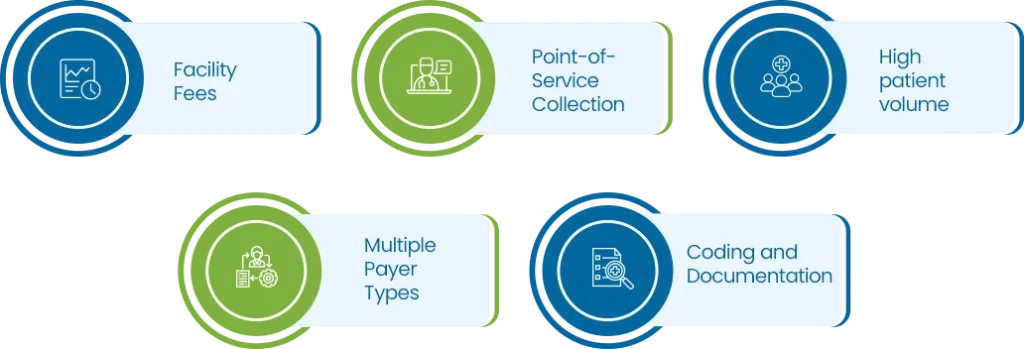
Facility Fees
Unlike a regular doctor’s office, urgent care centers often charge a facility fee in addition to the doctor’s fee. This fee helps cover the clinic’s overhead costs (staff, equipment, extended hours).
Point-of-Service Collections
Urgent care clinics usually collect payment at the time of service. Patients often pay a co-payment or coinsurance before leaving. Many urgent care centers even ask for full payment upfront if the patient is self-pay (i.e., no insurance). Collecting payments on the spot helps the urgent care avoid bad debt and keeps cash flow steady.
Multiple Payer Types
The insurance plans that urgent care centers must accommodate include private insurance companies, Medicaid (state insurance to the low-income patients), Medicare (government insurance to the aged and the disabled), and out-of-pocket insurance plans, just to mention a few. The rate and regulations could vary based on the payer type in the mechanism of urgent care reimbursement.
Coding and Documentation
Proper coding (with the proper code of diagnosis and procedure) and adequate documentation are the goals in urgent care billing. Records should clearly show what was done and why, because urgent care visits often combine an evaluation with a procedure such as suturing a laceration or taking an X-ray.
Place of Service Codes (Urgent Care POS)
When filling out an insurance claim, medical providers must include a Place of Service (POS) code, a two-digit code telling the insurer where the patient was seen. For urgent care billing, the code is 20, “Urgent Care Facility,” created by CMS to identify claims from urgent care centers.
What POS 20 Means
CMS defines POS 20 as a location, distinct from a hospital emergency room, an office, or a clinic, whose purpose is to diagnose and treat illness or injury for unscheduled, ambulatory patients seeking immediate medical attention. In simpler terms, POS-20 is for a walk-in urgent care setting, not an ER, not a regular doctor’s office.
Why the Correct POS Code Matters
Insurance companies process claims differently based on POS. Using the wrong code means your claim may be denied or paid at an incorrect rate.
When a Payer Expects POS-11 Instead
Most insurers follow the CMS guideline that urgent care visits should be billed with POS-20, unless your contract says otherwise. Some plans treat urgent care like a regular doctor’s office and expect POS-11.
If an urgent care is set up in an insurer’s system as a physician office, a claim submitted with POS-20 may be rejected. Check your contract before assuming.
Insurance and Urgent Care Reimbursement
Different payers handle urgent care billing in specific ways. Here is how each generally works, and what providers need to know.
Medicare
Medicare does not have distinct billing guidelines for urgent care, as opposed to routine outpatient care. Medicare patients’ bills for urgent care appointments are the same as those for regular office visits. You would use procedure codes for treatments performed, along with the standard evaluation and management (E/M) CPT codes.
Medicare does not cover urgent care S-codes. S9083 and S9088 are not recognized at all, because they sit outside the standard CPT/HCPCS set Medicare uses for payment.
After the patient’s Part B deductible is satisfied, Medicare Part B normally pays 80% of the authorized cost of an urgent care visit. The remaining 20% is paid by the patient or their secondary insurance.
Medicaid
Medicaid programs differ by state, but most adhere to CMS rules in the same way Medicare does. Urgent care services are billed on standard codes with the POS-20 code, and Medicaid covers medically necessary urgent care treatment for eligible patients.
Most of the time no referral is required. However, certain Medicaid plans or managed care organizations may require that the urgent care be in-network, or that some services be authorized in advance.
Payment depends on the state fee schedule, which may be lower than Medicare or private insurance. As with Medicare, no S-codes are submitted to Medicaid, use regular CPT codes for visits and procedures. Providers should refer to their state Medicaid provider manual for specific billing directives.
Private Insurance
Private plans often encourage patients to use urgent care instead of the ER for non-emergencies, so they usually cover urgent care visits with a set co-pay, for example, $30 or $50, that the patient pays.
Billing private insurers involves sending a claim, usually on a CMS-1500 form, with the appropriate codes.
98.5%
Clean Claims
Billing Challenges in Urgent Care?
We’re the specialists you need — accurate coding, faster claims, less denials.
Talk to an Expert35%
Reduction in A/R
Common Codes and Billing Procedures in Urgent Care
Coding translates the services you provide into standardized codes insurers recognize. There are two main types to consider: diagnosis codes and procedure codes.
Diagnosis Codes (ICD-10)
These codes describe the underlying problem and the reason the patient presented. Examples include S80.811A (abrasion, right lower leg, initial encounter) and J06.9 (acute upper respiratory infection).
Precise diagnosis coding shows the payer the visit’s medical necessity. Always use the most specific code available, if a patient has strep throat, use the code for streptococcal pharyngitis rather than a generic sore throat code.
Evaluation and Management (E/M) Codes
These CPT codes reflect the level of medical decision-making or the total time spent on the encounter. Since the 2021 guideline revision, history and exam no longer determine the level.
New patients
Those who have not received a professional service from a physician or qualified health professional of the same specialty and subspecialty in the same group within three years, are coded 99202 through 99205, since 99201 was eliminated.
Established Patients
Seen by the same group and specialty within the last three years, are coded 99211 through 99215. The level depends on the complexity of medical decision-making, or alternatively on total time spent on the date of the encounter. A complex visit addressing multiple problems may support 99204 or 99214, while a minor problem may only support 99202 or 99212. Choosing the right level matters in both directions, overcoding invites audits, undercoding leaves money on the table.
Urgent Care Specific Codes (S9083 and S9088)
These are HCPCS codes used mainly by certain private payers.
- S9088: services provided in an urgent care center, in addition to basic services.
An add-on code. If the insurer permits it, bill S9088 alongside the E/M code and any other procedure codes. It tells the payer the service was provided at an urgent care facility. - S9083: global fee for urgent care centers.
A flat-rate code. Use it only when a payer requires it under your contract. When billing S9083, you generally do not bill any other E/M or procedure codes for that visit, because the single case-rate is meant to cover everything.
Procedure and Treatment Codes
Urgent care performs many minor procedures and tests, each with its own CPT code.
| Service | Code | Applies to |
|---|---|---|
| Laceration repair | 12001 | Simple repair up to 2.5 cm, trunk or extremities |
| Laceration repair | 12002 | Simple repair, 2.6 to 7.5 cm |
| Abscess drainage | 10060 | Simple drainage of a skin abscess |
| Foreign body removal | 10120 | Simple removal from under the skin |
| Splint application | 29125 | Static forearm-to-hand splint |
| Splint application | 29105 | Long arm splint, shoulder to hand |
| X-ray imaging | 73080 | Elbow X-ray (each view set has its own code) |
| Rapid influenza test | 87804 | Flu swab performed in clinic |
| Pneumococcal vaccine | 90732 | Adult administration |
Avoiding Common Billing Pitfalls and Denials
Even when you know the basics, mistakes lead to denials or delayed payments. These are the pitfalls that recur most.
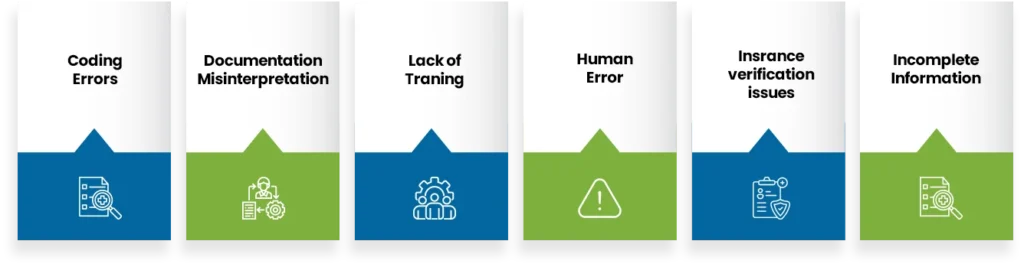
Coding and Documentation Errors
Missing or incorrect modifiers
Forgetting modifier 25 is among the most common urgent care billing mistakes. When a procedure and a significant, separately identifiable E/M service occur in the same visit, the 25 goes on the E/M code, never on the procedure. Use 59 for genuinely separate procedures.
Inadequate documentation
Insurers can reject claims when documentation contradicts what was billed — a complex laceration repair with no wound size recorded, or a 99215 supported by three lines of notes.
Global period issues
Some procedures carry a global period of 10 or 90 days during which routine follow-up is part of the original payment. Laceration repairs and fracture care are common examples. Billing a separate E/M during that window will usually be denied.
Overcoding or undercoding E/M levels
Coding every visit at level 4 invites an audit; habitual undercoding leaves money on the table. Let the actual complexity of the encounter choose the code.
Administrative and Front-Desk Errors
Incorrect patient or insurance information
A misspelled name, wrong date of birth, or outdated insurance ID gets the claim rejected outright. Verify demographics and eligibility at every check-in, not just the first.
Lack of awareness of payer rules
Some payers require prior authorization even in urgent care. Others deny a diagnosis code billed without a corresponding lab code. Keep a payer rules list where staff can reach it.
Timely filing limits
Filing deadlines run from 90 to 180 days or more from the date of service. A claim denied for late filing is usually not payable at all. Submit daily where possible, and never weekly at the slowest.
Conclusion
Urgent care billing works best when your team gets a few things right consistently. Write clear notes that show why the visit was necessary. Use the correct diagnosis and procedure codes, with the right modifiers. Put the correct place-of-service code on every claim. Verify insurance and obtain prior authorization when required, and collect patient payments at the time of service where possible.
Use your EHR and a payer rules list to help staff choose the right codes. Train front-desk and clinical staff on the common pitfalls, and track denials so recurring issues get addressed rather than repeated. Do these consistently and you will reduce denials, get paid faster, and keep your urgent care running smoothly.