
Medical billing and Revenue Cycle Management (RCM) depend on the accuracy of the Place of Service (POS) Coding Process. One of the most commonly used but misunderstood codes is POS 2, for inpatient hospital services. If POS 21 is billed incorrectly, it can lead to denials and delayed reimbursement from payers, as well as a risk of an audit by the payer; it may also create a compliance risk. As a result, practitioners, billing managers, coders, and healthcare administrators must understand how to properly use the POS 21 code to ensure clean claims and increase reimbursements from their respective payers.
In this blog, we will cover:
- POS 21 The Two-Digit Code That Can Make or Break Hospital Reimbursement
- When Should You Use POS 21?
- The Difference Most Practice Managers Understand Too Late
- Documentation Requirements for POS 21 Claims
- Why Documentation Accuracy Matters
- How POS 21 Impacts Reimbursement
- Common POS 21 Billing Mistakes
- Compliance Best Practices for POS 21 Billing
- How MedCare MSO Helps Improve POS 21 Billing Accuracy
POS 21 The Two-Digit Code That Can Make or Break Hospital Reimbursement
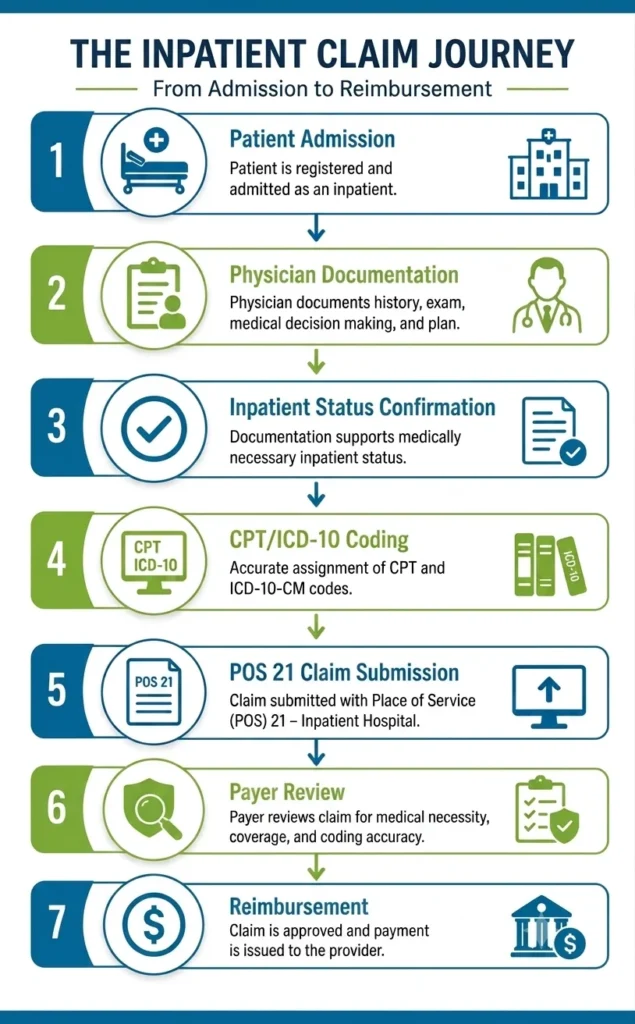
POS 21 in medical billing identifies the Inpatient Hospital as a location within the U.S.; this code reflects that the patient has been admitted as an inpatient and is receiving care at a hospital through a formal admission by their physician or by an emergency room visit pursuant to treatment that requires an overnight stay or includes an extended period of inpatient service.
In simple terms, Place of service 21 signifies to the payer that the patient received their care while being an inpatient, as opposed to through an out-patient clinic, the physician’s, or emergency room settings.
The POS code 21 is frequently used by Providers to report services on CMS 1500 claim forms and on electronic claims to identify the exact location of the service delivery.
When Should You Use POS 21?
When a patient officially becomes an in-patient in the hospital, the healthcare provider will report the patient as using the POS 21 hospital inpatient code when submitting the bill. This will usually happen when:
- Patients need to stay overnight for treatment
- There is a need for continual physician supervision of a patient receiving care
- Patients receive care needing advanced monitoring or treatment (for example: receiving oxygen)
- A patient requires surgery or intensive care
- The health status of the patient involves more than one (1) of the above situations
Examples of what is POS 21, and Billing Scenarios
Inpatient Surgery
In a surgery case where a patient is being admitted to the hospital for a cardiac bypass procedure and will require multiple days after surgery to recover, the healthcare provider will submit a bill for that patient with the appropriate procedure code(s) using a POS 21.
Intensive Care Unit (ICU) Admission
When a patient is being admitted to an intensive care unit (ICU), the hospital billing will reflect an inpatient status for that patient.
Complex Medical Conditions
Patients who have complex medical conditions requiring close medical monitoring, such as patients with sepsis, patients who have had a stroke, patients with significant respiratory distress, etc., typically qualify as inpatients.
The Difference Most Practice Managers Understand Too Late
One of the most common billing mistakes involves confusing POS 21 with POS 22.
POS 21 Inpatient Hospital
Used when:
- The patient is formally admitted
- Overnight or extended stay is expected
- Higher-level medical care is required
POS 22 Hospital out-patient code
Used when:
- Services are performed without formal admission
- The patient returns home the same day
- Observation services or minor procedures are provided
Key Differences Between POS 21 and POS 22
| Billing Element | POS 21 (Inpatient) | POS 22 (Out-patient) |
|---|---|---|
| Admission Required | Yes | No |
| Overnight Stay | Typically Yes | Usually No |
| Reimbursement Level | Higher | Lower |
| Care Complexity | High | Moderate |
| Facility Resources | Extensive | Limited |
Documentation Requirements for POS 21 Claims
Accurate documentation is critical when submitting claims with the in-patient POS code. Payers expect medical records to clearly support the inpatient admission decision.
To submit an in-patient POS-coded claim, you must provide accurate documentation. Having accurate documentation helps payers know how physicians made the inpatient admission decision, which is what we want as far as medical records are concerned. You must provide the following documentation to support the inpatient admission:
Required Documentation Includes
- Admission orders from the doctor;
- History and physical examination report;
- Progress notes;
- Diagnostic test results;
- Operative report if a procedure was performed;
- Documentation from nursing staff;
- Discharge summary.
Important Compliance Tip
A key compliance consideration: when documenting the inpatient admission, physicians need to provide clear justification for the medical necessity (as opposed to out-patient observation) of the inpatient admission. Incomplete documentation is a leading reason for an inpatient claim to be denied.
Why Documentation Accuracy Matters
Inadequate inpatient documentation is one of the primary reasons for delayed reimbursement and payer audits. According to Experian Health’s Claims Survey, Denials Still on the Rise Amid Escalating Challenges:
- 54% of providers said that they’re seeing an increase in claims being incorrectly submitted year over year.
- 68% of healthcare organizations believe that clean claims are harder to submit today than they were one year ago.
- The fastest-growing denial category in 2025 was clinical denial due to lack of medical necessity or authorization.
These trends further illustrate how critical accurate inpatient admission documentation and proper POS21 coding are for achieving both compliance and reimbursement success.
How POS 21 Impacts Reimbursement
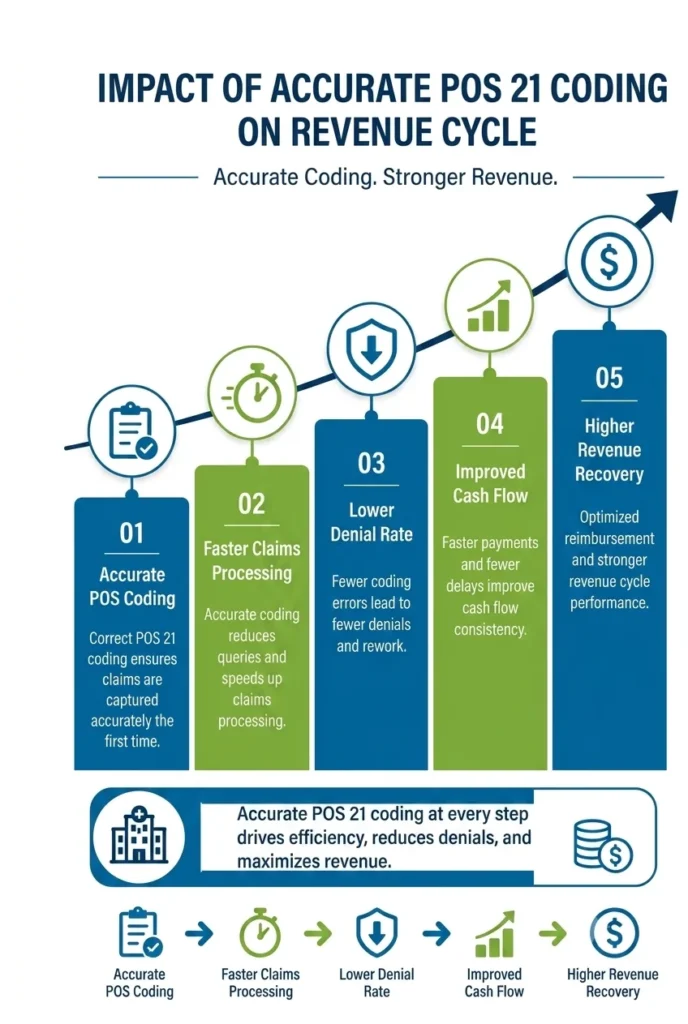
Determining where you performed your service (Place of Service 21) impacts how much your payer reimburses you for that service.
When you care for someone in an inpatient hospital setting, the resources used to provide care are greater than those used to provide out-patient care. Therefore, insurers will pay more for inpatient services than for out-patient services.
Inpatient services can include the following:
- Round-the-clock nursing care
- Specially designed equipment
- Intensive monitoring
- Surgical services
- Pharmacy/lab support
- Coordination of multiple specialties
In addition to looking at the POS code, payers also consider:
- ICD 10 diagnosis codes
- CPT/HCPCS procedure codes
- Documentation of medical necessity
- Length of stay
- DRGs
If you code incorrectly for the POS, you could experience the following issues:
- Underpayment
- Claim rejection
- Delayed payment
- Audit exposure
- Penalties for non-compliance
Common POS 21 Billing Mistakes
Inpatient claims can be mistaken by both novice and seasoned billing staff alike.
1. Using POS 21 Without Formal Admission
If POS 21 is used when the patient was not formally admitted to the hospital, the bill can be denied.
2. Confusing Observation Services With Inpatient Care
Observation services are frequently confused with inpatient services and incorrectly billed as if they were inpatient admissions.
3. Incomplete Documentation
Denials occur when documentation does not provide complete information (such as missing orders from the physician or insufficient documentation of medical necessity).
4. Incorrect CPT or ICD-10 Pairing
When CPT and ICD-10 codes do not correspond properly on an inpatient claim, the hospital may incur an expense.
5. Failure to Verify Payer Rules
Different payers may require different criteria to authorize inpatient care; therefore, the provider should always confirm what is required by each payer and ensure that documentation is complete and supports the request for inpatient authorization.
Compliance Best Practices for POS 21 in Medical Billing
The best practices to improve claim accuracy and reduce denials include the implementation of a strong compliance program by healthcare organizations.
Best Practices Recommended
- Conduct Routine Coding Audits
To identify any inconsistencies in coding, review patient accounts within your facility frequently. - Train Employees on Coding and Charging
To keep billing and coding staff current on CMS updates and payer-specific inpatient billing requirements, it is important to provide them with ongoing education. - Validate Admission Status Early
Prior to submitting claims for inpatient admissions, confirm the inpatient admission. - Enhance Clinical Documentation
Use Clinical Documentation Improvement (CDI) specialists to assist you in enhancing the supporting documentation to demonstrate medical necessity. - Utilize AI-Based Coding Tools
Automating the coding process can help reduce the number of errors made by manual coding, thereby improving claim accuracy.
How MedCare MSO Helps Improve POS 21 Billing Accuracy
Internally managing inpatient billing at a facility can be complicated and time-consuming. Many healthcare facilities deal with denial management and payer compliance issues and struggle with obtaining accurate documentation.
By utilizing all-inclusive services that fit the needs of your Practice, MedCare MSO will help you optimize your facility’s revenue cycle.
MedCare MSO offers:
- AI Medical Billing Services
- AI Coding Solutions
- Denial Management
- Claims Scrubbing
- Compliance Auditing
- Revenue Cycle Management
- Billing Software Integration
Value Added Services:
- BI Reporting Services
- Robotic Process Automation Services
- Healthcare Data Integration Solutions
- QMS and Lean Six Sigma Solutions
Final Thoughts
Healthcare providers, coders, billing departments, and hospital administrators must understand the meaning and use of the Place of Service Code 21 either on their own or via a professional service. The Code POS 21 will identify all services provided to a patient while they are within the confines of a hospital, and is critical in clearly identifying services provided to patients for the purposes of reimbursement, claims compliance, and denial of service prevention. Proper documentation, as well as the use of specific coding and payer for that service, must be adhered to for the successful processing of claims in all areas.
If your organization would like assistance improving the accuracy of your inpatient hospital billing, reducing denials on claims submitted for inpatient services, or maximizing the performance of your revenue cycle, MedCare MSO has the expertise and technology solutions you need to succeed.