MedCare MSO DME billing services handle DMEPOS coding, documentation, capped-rental tracking, prior authorization, and denial management, so your claims are built to match payer policy the first time. Outsource DME billing to a team that knows HCPCS, modifiers, and DME MAC rules as well as your equipment. Our DME billing services are built for DMEPOS suppliers, not adapted from a physician workflow.
Book A Free ConsultationDMEPOS suppliers deliver important medical equipment that includes oxygen and mobility to CPAP and diabetic supplies. Each order carries a huge billing risk. Our DME billing services turn that risk into actual collected revenue through cleaner claims, fewer denials, and faster payments. These are the results MedCare MSO clients see on average when billing runs clean.
96%
Collection Ratio
98.5%
First Pass Clean Claims Rate
Up to 35%
Revenue Increase
35%
Reduction in A/R
Most of the DME denials circle around a short list of challenges and failures. We work on our claims to avoid each one and work the denials that still happen through our denial management services.
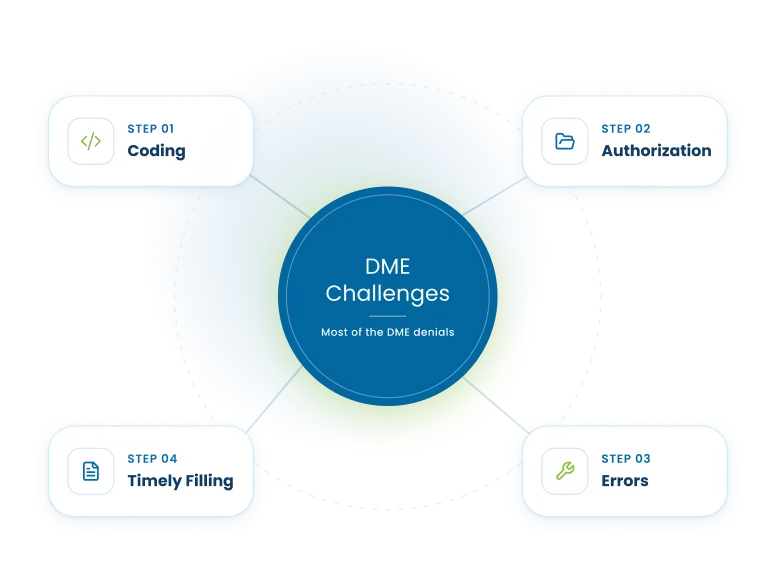
DMEPOS billing is unusually error-prone, and the repayment is dependent on equipment-specific coding, documentation, coverage, authorization, and rental-versus-purchase rules that shift by item and payer. That's why suppliers use specialist medical billing services instead of building the expertise in-house. The right DME billing company earns its fee by closing the gaps that quietly cost suppliers revenue.
Here are the ways we stop the leaks in your revenue stream:
One DME-literate biller is hard to hire and costly to keep, and when they are out, claims stop. A specialist team means no ramp-up and no coverage gaps.
DME recoupments can occur weeks after delivery. Our team identifies problematic claims before submission, which helps prevent avoidable losses.
Backlogged claims get worked down, meaning that you can enjoy flexible expansion without increasing your headcount.
The DMEPOS industry is heavily regulated. We keep track of all orders, including receipt of the medical necessity and delivery history, so documentation is ready if an order is audited.
Fixing why a denial happened stops the next fifty, not just the one in front of you.
You will always be able to see all the key denial statistics, A/R aging, and your collection performance against your benchmarks.
DME claims processing follows the same revenue cycle for every order, from eligibility verification to paid claim. We handle everything with our own team or collaborate with yours whenever needed.
We bill the full DMEPOS range. Codes below are illustrative; our team confirms current HCPCS before every claim.
A HCPCS code alone is not enough to get a DME claim paid. Payment is determined by the code, diagnosis, modifier, documentation, and payer policy together.
HCPCS Level II and ICD-10-CM
Each durable medical equipment (DME) claim involves the pairing of a HCPCS Level II code with an ICD-10-CM diagnosis that establishes medical necessity. The identified units, date, and place of service must be the same as when the item was supplied; the claim is sent under the CMS-1500 form identified as an 837P transaction. We verify each of these before submitting the claim.
DME Billing Modifiers
Modifiers tell the payer how the item was supplied, the difference between payment and recoupment.
DMEPOS runs on two very different rulebooks. Medicare is national and policy-driven; Medicaid changes state by state. Our DME billing services build each claim to the one that governs it.
We build each Medicare claim to the national coverage rules and, where they apply, the governing DME MAC LCD and Policy Article, in line with CMS DMEPOS payment policies.
MedCare MSO offers four connected RCM products that streamline DME billing end-to-end: an EHR, an AI Scribe, an AI Coder, and a PMS. Take the full AI ecosystem or pick a single component; either way, our team integrates with your existing EHR, so you get tools built around how DMEPOS suppliers actually work.
Explore the AI SuitePlenty of companies will send your claims. Fewer understand DME. As a DME medical billing company, MedCare MSO combines DMEPOS expertise with technology and follow-through that shows up in your collections.
Get a Free DME Billing Analysis