Are you still struggling to manage dermatology billing and coding? MedCare MSO delivers dermatology billing services from certified derm coders who know lesion coding, modifier rules, and how multi-procedure visits actually work, backed by dermatology denial management that cuts denials and gets you paid faster.
Book A Free ConsultationDermatology practices running high procedure volume need dermatology billing services that hold up to strict modifier and medical necessity guidelines. Errors can lead to denials that add up over time and cause revenue loss. This is what a specialized dermatology billing company can offer when proper claim coding and scrubbing practices are applied.
96%
Collection Ratio
98.5%
First Pass Clean Claims Rate
Up to 35%
Revenue Increase
35%
Reduction in A/R
Dermatology bills more procedures per visit than almost any specialty. A single patient may need a biopsy, a destruction, and a same-day E/M on a single claim. Each of these carries a modifier rule and a medical necessity threshold that has to hold on its own. Here is where practices lose revenue.
Even a single appointment could involve performing an exam, biopsy, and destruction, all of which require their own CPT coding, modifiers, and medical necessity. Forgetting one detail can bundle or deny the whole claim
A benign lesion removed because it bleeds or hurts is covered, but the same removal for appearance is cosmetic and patient billed. Documentation and diagnosis coding decide which way the procedure gets paid.
Same-day E/M plus a procedure needs modifier 25, and separate lesions or sites need modifier 59 or XS to clear NCCI edits. If modifiers are inappropriately coded, then services that should be billed separately will be billed together.
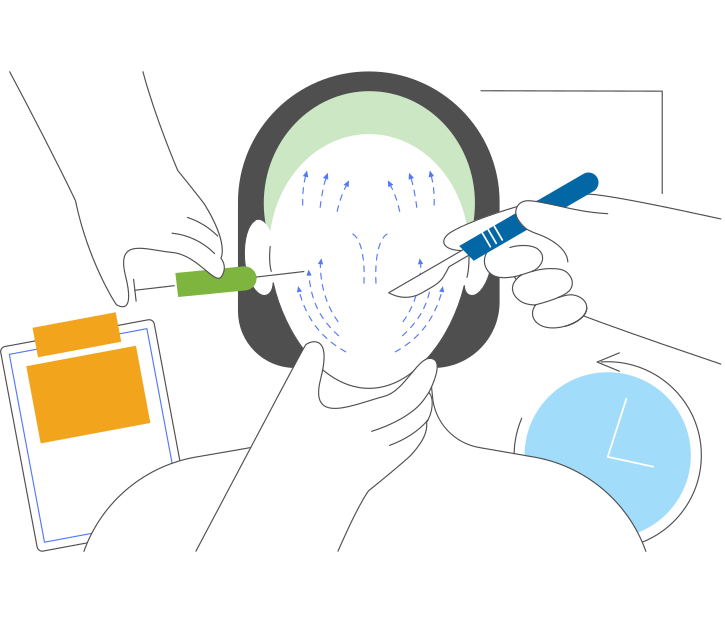
Excision CPT is chosen by lesion size plus margins and by the site. The size has to be measured and documented before excision, margins included, because each size tier pays differently. A measurement taken after removal, or a note missing margins, downcodes the claim and shorts the reimbursement.


Stage-by-stage Mohs billing requires precise documentation at every stage of the procedure, including defect size and method of repair employed. If anything is missed, the facility loses out on the revenue of surgical and reconstructive procedures.
NCCI edits group together multiple same-day pairs, and procedures carry global periods. Staged work uses modifier 58, unrelated same-global visits use modifier 24, and unrelated procedures use modifier 79.
Get Started TodayWe run full dermatology revenue cycle management to help you capture more of what you've earned while staying audit-ready. Each step below connects into one accountable workflow:
We bill E/M visits and minor procedures with the diagnosis specificity payers require for medical necessity including for acne (L70.0), psoriasis (L40.x), dermatitis (L20.x–L30.9), and rosacea (L71.x).
Biopsies, excisions, destructions, and repairs are coded based on the technique used, site of the procedure, and excised size, with intermediate and complex closures reported separately. Diagnosis carries the claim e.g. D22.x/D23.x supports benign excisions and C43.x and C44.x support malignant ones.
Mohs surgery billing (CPT 17311–17315) follows a staged approach, where code selection considers stage and number of tissue blocks. Same-day reconstruction is coded separately, and modifier 58 applies when a planned repair falls within the global period of a related prior procedure. The surgeon or pathologist hybrid complicates the frozen-section pathology coding process, but our coders know how to deal with it.
Most routine dermatopathology specimens are Level IV (88305); a narrower set, skin cyst, tag, and debridement specimens, falls to Level III (88304). When the lab and reading are split, the technical and professional components (TC/26) are billed separately, and component errors are a common source of unpaid or short-paid claims.
Most cosmetic procedures do not have special coverage, so the risk is compliance and not coding. We bill patients according to their responsibility and apply the ABN workflow with GA/GX/GY/GZ modifiers.
Pediatric derm brings age-specific diagnosis coding for conditions like infantile hemangiomas, molluscum, and atopic dermatitis. It also adds consent and guarantor considerations that adult-focused billing teams routinely miss, so we build them into the workflow.
Synchronous video visits and store-and-forward consultations have different rules: POS codes 02 and 10, modifier 95, and coverage and payment-parity rules that vary by payer. We apply each payer's telehealth rules so your virtual-visit revenue stays as clean as your in-person consultations.
Bill a sub-specialty we didn't list, or a mix of them? We handle the full range.
Schedule a CallbackOur dermatology coding services handle each and every one of these code types every day, which is what distinguishes dermatology specialty billing services from other generic teams.
Accurate dermatology coding services start with the right reference. These codes are just a few examples of dermatology codes, and a certified coder must check them all against the current AMA CPT and ICD-10 edition. The rules of coverage comply with CMS and Medicare contractor regulations, and the clinical recommendations are guided by American Academy of Dermatology.
Our dermatology billing services connect to a complete AI ecosystem that runs the derm revenue cycle from the exam note to the posted payment. Take the full stack as an all-in-one solution, or connect a single piece to the platform you already run.
Explore the AI SuiteWe bill inside the platform your practice already runs, with no migration. That includes dermatology-native systems like ModMed EMA, Nextech, and EZDERM, plus general platforms from Epic and eClinicalWorks to AdvancedMD, Kareo and Tebra, DrChrono, athenahealth, and NextGen. Our coders know where each stores biopsy counts, lesion sites, and modifier flags.
Dermatology coverage shifts by payer. Medicare sets lesion and biopsy rules through local coverage determinations that vary by MAC, Medicaid adds prior authorization triggers, and commercial carriers publish their own medical necessity policies. We match diagnosis to procedure against the applicable LCD or NCD, apply an ABN when a service reads as cosmetic, and bill Aetna, Blue Cross Blue Shield, UnitedHealthcare, Cigna, and Humana.
Dermatology has its own MIPS measures, such as melanoma coordination of care and timely biopsy result reporting, and choosing the wrong ones costs points before the year even starts. We help your practice select the measures that fit its procedure mix, capture the quality data inside the billing workflow rather than as separate chart abstraction, and track performance thresholds through the year, so everything is documented accurately ahead of attestation. Final payment adjustments are set by CMS based on your MIPS score.
Dermatology charts carry clinical photographs, including full-face images that are themselves PHI identifiers, so data security is not optional paperwork. Operations run under HIPAA and SOC 2 Type II controls, with encryption in transit and at rest, role-based access to every chart, and recurring staff security training. We support the audits dermatology practices actually face, from TPE and RAC to UPIC reviews and ADR requests, with organized documentation ready when a records request arrives, and AAPC and AHIMA-certified coders handling your coding throughout.
Plenty of billing companies will take a dermatology client. Far fewer can handle Mohs surgery billing stage by stage, defend a modifier 25 under audit, or tell a payer why a symptomatic seborrheic keratosis is not cosmetic. Practices that outsource dermatology billing to MedCare MSO get specialty-trained teams backed by the infrastructure we bring to 50+ specialties and practices of every size nationwide.
Get a Free Billing Analysis